She Thought the Colonel’s Rank Made Her Untouchable. Ten Minutes Later, the Gate Exposed the Secret Her Husband Had Been Hiding for Years.
Chapter 1 — The Sound Across the Asphalt
The sound of the strike traveled farther than anyone expected.
It cracked across the blistering pavement of the military airfield checkpoint, sharp enough to turn heads fifty yards away and sudden enough to make two Military Police officers instinctively stiffen.
Specialist Maya Lin’s patrol cap dropped from her head.
It landed in the dust beside her boot.
For half a second, no one moved.
Maya was twenty-two years old, five feet four inches tall, and still young enough that strangers sometimes mistook her for a college student when she was out of uniform. Her dark hair was pinned tightly beneath the regulation cap that now lay on the ground. Her face was narrow, composed, and usually difficult to read.
At that moment, however, a red mark was spreading across her left cheek.
Victoria Sterling stood less than two feet away.
The Colonel’s wife lowered her hand slowly, almost as though she were surprised by what she had just done.
Then the surprise disappeared.
Her anger returned.
“Do you have any idea who I am?”
Maya kept her eyes fixed ahead.
She could taste blood where she had accidentally bitten the inside of her cheek, but she refused to touch it.
Victoria leaned closer.
“You look at me when I’m speaking to you.”
Maya did not move.
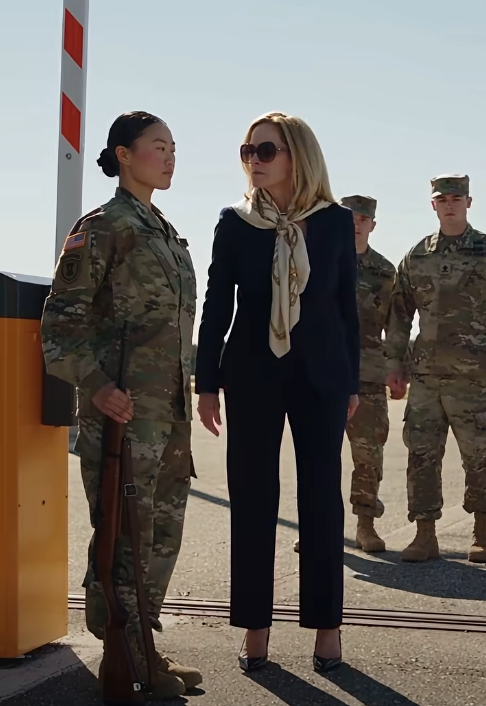
Around them, the heat shimmered above the asphalt. Diesel exhaust hung in the air from idling military vehicles. A temporary steel barricade crossed the access road leading toward the VIP section of the airfield.
Beyond that barricade, preparations were underway for an arrival almost no one on the installation had been told about.
That was why Maya had been placed there.
That was why the gate had been closed.
And that was why the instructions issued that morning had been unusually simple.
No civilian vehicle crossed the checkpoint without specific authorization. No exceptions.
Victoria Sterling apparently considered herself the exception.
Her cream silk scarf shifted in the dry wind.
“You are nothing but military garbage,” she said. “An incompetent little nobody wearing a uniform because it makes you feel important.”
Maya’s fingers tightened against the seam of her trousers.
Her father’s voice entered her mind.
Not loudly.
Minh Lin never spoke loudly.
He had immigrated to the United States when he was twenty-three with two suitcases, seventy-eight dollars, and enough English to ask where the bus station was.
For almost thirty years, he had repaired engines.
Cars.
Delivery vans.
Generators.
Anything with bolts, belts, fuel lines, or broken metal.
When Maya finished basic training, Minh had stood beside the parade field wearing the same gray suit he wore to weddings and funerals.
He had cried without embarrassment.
Later, while Maya laughed at him, he had touched the American flag patch on her shoulder.
“Never forget,” he had told her, “the uniform is not important because people must respect you.”
He had paused.
“It is important because you must respect what it asks from you.”
Maya heard those words now.
Victoria stepped closer.
“I asked you a question.”
Maya finally answered.
“Ma’am, your vehicle does not have authorization to proceed beyond this checkpoint.”
Victoria gave a short, disbelieving laugh.
“My husband commands this brigade.”
“Yes, ma’am.”
“Then move the barricade.”
“I cannot do that.”
Victoria’s expression hardened.
“You mean you won’t.”
Maya looked directly ahead.
“I mean I cannot.”
Several feet away, PFC Jackson glanced toward PFC Miller.
Neither young MP wanted to become part of this.
Everyone on the installation knew Colonel Richard Sterling.
More importantly, everyone knew his wife.
Victoria attended ceremonies as though she were inspecting troops herself. She corrected young soldiers for failing to greet her. She expected parking spaces to be cleared before she arrived. She had once forced an enlisted family to leave a reserved picnic area because she claimed the view belonged to senior officers.
Complaints disappeared.
People stopped making them.
Richard Sterling was ambitious, well-connected, and widely expected to receive his first general’s star within eighteen months.
No young soldier wanted to become the reason that ambition stalled.
Victoria pointed toward her silver Mercedes parked sideways across the access lane.
“I have driven through this gate dozens of times.”
“Not during this security condition.”
“And who exactly is arriving?”
“I’m not authorized to discuss that.”
Victoria stared at her.
Then she laughed.
“You don’t even know, do you?”
Maya said nothing.
“You’re standing out here pretending to have authority because someone handed you a barricade.”
Maya’s cheek burned.
Her humiliation was worse than the pain.
Soldiers nearby were watching.
Some pretended not to.
Others did not bother pretending.
Victoria turned toward Jackson and Miller.
“Guards!”
Both MPs stiffened.
“Remove her.”
Jackson blinked.
“Ma’am?”
Victoria jabbed a finger toward Maya.
“She is refusing a direct order from the brigade commander’s family.”
Jackson looked miserable.
“Mrs. Sterling, Specialist Lin is following an installation directive.”
Victoria stepped toward him.
“Do you enjoy being stationed here, Private?”
Jackson swallowed.
“Yes, ma’am.”
“You have a wife?”
His face changed.
Victoria smiled slightly.
“Interesting.”
Maya turned her eyes toward Jackson for the first time.
Fear was visible on his face.
Not fear of Victoria physically.
Fear of what one phone call could do.
A transfer.
A ruined evaluation.
A career stalled before it began.
Victoria knew it too.
“Take her away.”
Jackson hesitated.
Miller whispered, “Jackson…”
Victoria snapped her fingers.
“Now.”
Jackson reluctantly walked toward Maya.
His hand moved toward her sleeve.
“Specialist Lin,” he murmured, “please don’t make this harder.”
Something inside Maya broke.
Not discipline.
Something quieter.
She had obeyed.
She had done exactly what was required.
And somehow she had still become the problem.
Her eyes closed briefly.
Jackson’s fingers were inches from her arm.
Then the checkpoint filled with the low mechanical growl of a heavy engine.
Every head turned.
A matte-black armored Chevrolet Suburban rounded the corner from the taxiway.
It moved slowly.
Deliberately.
Dust coated its doors and grille.
No flags.
No ceremonial markings.
No obvious escort.
Yet Jackson immediately stepped backward.
Military people learned to recognize authority even when authority arrived without decorations.
The Suburban continued forward.
Victoria’s Mercedes blocked half the lane.
The armored vehicle stopped only inches from its rear bumper.
Victoria spun around.
Her humiliation instantly found a new target.
“Oh, absolutely not.”
The Suburban remained silent.
Victoria marched toward it.
“Whoever you are, move that thing!”
The engine shut off.
For three seconds, nothing happened.
Then the driver’s door opened.
Sergeant First Class Marcus Brody stepped onto the pavement.
He was broad-shouldered, close to fifty, with a weathered face and a faint limp caused by the prosthetic below his right knee.
Brody looked at no one.
He walked around the Suburban.
Stopped beside the rear passenger door.
Straightened.
And opened it.
A black combat boot touched the gravel.
Then a woman stepped into the North Carolina sunlight.
She was perhaps sixty.
Silver streaked her dark hair.
Her uniform was ordinary field camouflage rather than ceremonial dress.
Nothing about her arrival was theatrical.
She did not need theater.
The entire checkpoint seemed to recognize something before anyone consciously understood why.
Victoria started toward her.
“Listen here, whoever you are—”
Then sunlight struck the insignia.
Victoria stopped.
Maya’s breath caught.
Jackson’s face emptied of color.
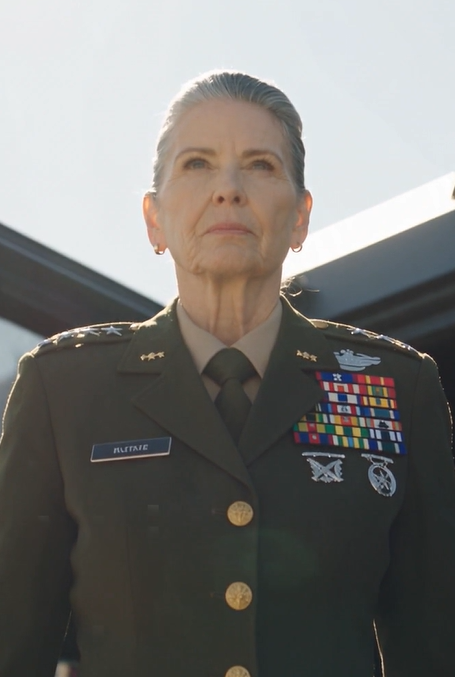
Five silver stars gleamed against the uniform.
Five.
The woman was General Evelyn Vance.
The newly appointed Army Chief of Staff.
Known in senior military circles as the Iron Vanguard.
And she was staring directly at Maya’s face.
Chapter 2 — Ten Minutes
Jackson and Miller saluted so quickly that the equipment on their belts rattled.
Maya did the same despite the burning ache across her cheek.
General Vance returned the salute.
“Drop it, Specialist.”
Maya lowered her hand.
“Yes, General.”
Vance’s eyes moved from Maya’s cheek to the patrol cap lying in the dust.
Without speaking, she bent down.
A five-star General bent down at the feet of a twenty-two-year-old Specialist.
The entire checkpoint watched.
Vance picked up the cap.
Brushed the dust away.
Then handed it back.
“Put your cover on.”
Maya’s fingers trembled as she took it.
“Yes, General.”
Only after Maya had replaced the cap did Vance turn toward Victoria.
Victoria looked physically smaller.
“General Vance,” she said quickly. “I had no idea you were coming so early.”
Vance said nothing.
“I’m Victoria Sterling. Colonel Richard Sterling’s wife.”
“I know.”
Victoria forced a smile.
“There has been a misunderstanding.”
Vance looked toward Maya’s cheek.
“Was there?”
Victoria’s mouth opened.
Maya saw the exact moment Victoria considered lying.
She thought better of it.
“This soldier was being extremely disrespectful.”
Vance looked at Maya.
“Were you?”
“No, General.”
Victoria stepped forward.
“She refused to follow my instructions.”
Vance turned back.
“You are a civilian.”
Victoria blinked.
“My husband—”
“Is a Colonel.”
The words were quiet.
“He wears his rank. You do not.”
No one moved.
Vance continued.
“Did you strike this soldier?”
Victoria’s face tightened.
“It was an emotional moment.”
“That is not what I asked.”
Victoria swallowed.
“Yes.”
Vance nodded once.
Then she looked toward Jackson and Miller.
“Were you about to remove Specialist Lin from this checkpoint?”
Jackson looked sick.
“Yes, General.”
“Why?”
“Mrs. Sterling ordered us to.”
“Does Mrs. Sterling command Military Police personnel?”
“No, General.”
“Then why were you obeying?”
Jackson’s eyes dropped.
Vance waited.
Finally, Jackson answered.
“She threatened our careers.”
Victoria snapped toward him.
“You spineless little—”
Vance raised one finger.
Victoria stopped speaking.
The silence that followed was worse than shouting.
General Vance turned toward Brody.
“Sergeant First Class.”
“Ma’am.”
“Contact the Provost Marshal.”
“Yes, ma’am.”
“Have a full escort sent here.”
Brody reached for his radio.
“And Sergeant?”
“Ma’am?”
“Tell Colonel Sterling he has ten minutes to report to this checkpoint.”
Victoria’s face changed.
Vance looked directly at her.
“You wanted to discuss protocol.”
A faint smile appeared.
“Your husband and I will discuss it together.”
Victoria said nothing.
The countdown began.
For the next several minutes, almost no one spoke.
Maya stood near the barricade, trying to calm the pulse pounding behind her eyes.
General Vance walked toward the black Suburban.
Maya expected her to leave the confrontation to the Provost Marshal.
Instead, Vance stopped beside Victoria’s Mercedes.
Her gaze moved over the car.
Luxury sedan.
Temporary base access permit.
VIP windshield placard.
Then she paused.
Her expression changed.
Only slightly.
Maya almost missed it.
Vance leaned toward the passenger side.
The rear window was partially lowered.
Inside sat several shopping bags, a leather purse, a garment bag, and a small black case.
Nothing unusual.
Except General Vance stared at the black case for several seconds.
Brody noticed.
He walked over.
Neither spoke.
Victoria followed their gaze.
“That’s private property.”
Vance looked at her.
“I did not ask.”
Victoria folded her arms.
Maya watched Brody carefully.
He had become suddenly alert.
Not angry.
Alert.
His eyes moved toward Vance.
Vance gave the smallest shake of her head.
Do nothing.
Not yet.
Sirens appeared faintly in the distance.
Victoria heard them too.
Her confidence continued to dissolve.
Then another vehicle approached from the opposite road.
A government sedan.
It stopped beyond the barricade.
The rear door opened.
Colonel Richard Sterling stepped out.
He was tall, silver-haired, and immaculate.
Even in field uniform, he looked as though someone had ironed every crease immediately before he arrived.
He walked quickly toward the checkpoint.
He saw his wife.
Then Maya.
Then General Vance.
His pace slowed.
For the first time, something almost resembling fear crossed Richard Sterling’s face.
It disappeared instantly.
He saluted.
“General.”
Vance returned it.
“Colonel.”
Richard looked at Victoria.
“What happened?”
Vance answered before she could.
“Your wife struck a soldier.”
Richard’s jaw tightened.
“Victoria?”
“She also ordered Military Police personnel to arrest that soldier for enforcing a base command directive.”
Richard looked toward Maya.
His eyes were calm.
Too calm.
“Specialist?”
“Sir.”
“Were you disrespectful toward my wife?”
Vance’s head turned slowly.
Maya hesitated.
“No, sir.”
Richard looked back at Vance.
“There must be context.”
“Interesting.”
Vance stepped closer.
“I watched most of it.”
Richard’s expression froze.
Victoria stared at her.
“You watched?”
Vance nodded.
“My vehicle reached the corner before Sergeant Brody drove into view.”
Maya felt a chill despite the heat.
General Vance had witnessed more than anyone realized.
Richard recalculated immediately.
“Then, General, I apologize for my wife’s behavior.”
Victoria turned sharply.
“Richard—”
“Enough.”
It was the first time he had spoken harshly to her.
She went silent.
Richard continued.
“I will personally ensure appropriate corrective action.”
Vance looked almost amused.
“You believe this is your matter to correct?”
Richard’s face tightened.
“No, General.”
“Good.”
The Provost Marshal vehicles arrived.
Four Military Police officers stepped out.
Their commander, Major Olivia Grant, walked directly toward Vance.
“General.”
“Major.”
Vance gestured toward Victoria.
“Mrs. Sterling is to remain here pending formal statements.”
Victoria stared.
“You’re detaining me?”
Grant answered calmly.
“You are being asked not to leave.”
“I’m a civilian.”
“Yes, ma’am.”
“My husband commands this brigade.”
Major Grant looked briefly toward Richard.
Then back at Victoria.
“Not this checkpoint.”
Something changed in Richard Sterling’s eyes.
Maya saw it.
Again, it was only an instant.
But this time it was not embarrassment.
It was calculation.
Vance saw it too.
She turned toward him.
“Colonel, how many times has your wife crossed controlled airfield checkpoints in the past sixty days?”
Richard blinked.
“I don’t know.”
Victoria looked confused.
Vance continued.
“Estimate.”
“I couldn’t possibly.”
“Interesting.”
Richard’s shoulders stiffened.
“General, with respect, what does that have to do with today?”
Vance looked toward the Mercedes.
“Perhaps nothing.”
She paused.
“Perhaps everything.”
Chapter 3 — The Visit Nobody Knew About
Maya expected the incident to end with statements.
It did not.
Within forty minutes, the airfield had transformed.
Additional Military Police arrived.
Two plainclothes investigators appeared.
Then another vehicle carrying personnel Maya did not recognize.
The black case in Victoria’s Mercedes remained untouched.
Richard Sterling was told to surrender his government phone temporarily.
That was when his calm finally cracked.
“On whose authority?”
General Vance looked at him.
“Mine.”
Richard said nothing.
Maya was moved to a nearby administrative building and placed in an empty conference room.
She sat alone with a paper cup of water.
Her cheek had begun swelling.
Someone brought her an ice pack.
She did not use it.
She stared at the table instead.
Her hands were still trembling.
A knock came.
PFC Jackson entered.
He had removed his helmet.
Without it, he looked younger.
Maybe twenty.
Maybe nineteen.
“Can I come in?”
Maya nodded.
Jackson stood awkwardly.
“I’m sorry.”
She looked at him.
He swallowed.
“I shouldn’t have moved toward you.”
Maya said nothing.
“I knew the order was lawful.”
Silence.
“I knew she didn’t have authority.”
Maya finally spoke.
“Then why did you do it?”
Jackson’s face tightened.
“My wife is pregnant.”
Maya’s expression changed.
“She’s due in three months.”
He looked toward the door.
“I heard what Mrs. Sterling has done to people. Reassignments. Evaluations. Calls to commanders. I thought if I resisted…”
He stopped.
Maya understood.
That made it worse.
Because she had been afraid too.
Jackson continued.
“That doesn’t excuse it.”
“No.”
He nodded.
“I know.”
Maya looked at the ice pack.
“My father says fear doesn’t make a decision wrong.”
Jackson waited.
“It just explains why you were tempted to make it.”
He gave a small, painful smile.
“Your father sounds smarter than me.”
“He’ll be happy to hear that.”
Jackson almost laughed.
Then his face became serious again.
“I’m sorry, Specialist.”
Maya nodded.
“I believe you.”
He left.
Ten minutes later, General Vance entered.
Alone.
Maya stood immediately.
“Sit.”
Maya sat.
Vance took the chair across from her.
For a moment, the most senior officer in the United States Army simply studied the young Specialist.
“How is your face?”
“Fine, General.”
“It is visibly swelling.”
“Yes, General.”
“That is not usually how people define fine.”
Maya almost smiled.
Almost.
Vance leaned back.
“You did well.”
Maya looked down.
“I just followed the order.”
“That is why you did well.”
Vance’s tone changed.
“Do you know why I came here today?”
“No, General.”
“Good.”
Maya blinked.
Vance continued.
“Almost no one did.”
“Was it an inspection?”
“Partly.”
“Partly?”
Vance folded her hands.
“For eight months, the Army has been reviewing irregular security access involving this installation.”
Maya stopped breathing for a second.
Vance watched her reaction.
“Nothing has been proven yet.”
“Yes, General.”
“Certain controlled components disappeared from secured storage.”
Maya said nothing.
“Not weapons.”
Vance paused.
“Communications equipment.”
The air conditioner hummed overhead.
“Equipment that should be almost impossible to remove without multiple signatures.”
Maya felt a knot forming in her stomach.
“What does that have to do with the gate?”
“Perhaps everything.”
Vance looked toward the window.
“Someone discovered that official vehicle logs did not match camera records.”
Maya frowned.
“Meaning?”
“Vehicles crossed checkpoints without being entered into the system.”
“How?”
“That is what we are here to determine.”
Maya thought of Victoria.
Her confidence.
Her claim that she had crossed the gate dozens of times.
Vance saw the realization.
“Exactly.”
Maya looked toward the door.
“Mrs. Sterling?”
“We don’t know.”
“Colonel Sterling?”
“We don’t know.”
Maya hesitated.
“Then why tell me?”
Vance looked directly at her.
“Because you are now part of the chain.”
Maya’s stomach dropped.
“I don’t understand.”
“You refused an unauthorized vehicle during a security lockdown.”
“Yes.”
“That refusal created a documented access denial.”
Maya waited.
“It is the first one involving Victoria Sterling’s vehicle in sixty-three days.”
The number struck Maya harder than the slap.
Sixty-three days.
“How many times did she cross before?”
“We’re finding out.”
Maya remembered Victoria’s words.
I go wherever I want.
Vance stood.
“Specialist Lin.”
Maya stood too.
“Do not discuss this outside official interviews.”
“Yes, General.”
“And one more thing.”
“Yes?”
Vance glanced toward Maya’s cheek.
“What happened to you today was not your fault for following orders.”
Maya nodded.
Vance continued.
“But do not make the mistake of believing rank automatically creates courage.”
She opened the door.
“Sometimes courage is simply the person at the lowest gate saying no.”
Then she left.
Chapter 4 — The Colonel Without a Brigade
By evening, Richard Sterling no longer commanded the brigade.
The announcement spread through Fort Liberty faster than any official message.
Temporarily relieved pending investigation.
Those were the words.
No accusation.
No charge.
No conclusion.
But soldiers understood what temporary relief meant when the Army Chief of Staff herself had arrived unexpectedly.
Rumors exploded.
Some said Richard had insulted Vance.
Others claimed Victoria had been arrested in handcuffs.
Neither was true.
Victoria had been transported to the Provost Marshal’s office and released several hours later pending investigation into the incident with Maya.
Richard remained on installation.
His access privileges changed.
His command authorities disappeared.
Maya went home at 2100.
Her father was waiting in the kitchen.
Minh Lin stood beside the stove with a bowl of soup.
He looked at her face.
Everything in him stopped.
“What happened?”
Maya put down her bag.
“It looks worse than it is.”
Minh’s voice became very quiet.
“Who?”
Maya sat.
“A Colonel’s wife.”
Her father stared.
Then he pulled out the chair across from her.
“Tell me.”
So Maya did.
Not everything.
She could not discuss the investigation.
But she told him about Victoria.
The checkpoint.
The MPs.
The armored SUV.
General Vance.
When she reached the part about the General picking up her cap, Minh lowered his eyes.
Maya noticed.
“What?”
“Nothing.”
“You’re smiling.”
“No.”
“You are.”
Minh stood and turned toward the stove.
Maya watched him.
“Dad.”
He stirred the soup unnecessarily.
“Five-star General picked up your hat.”
“Cap.”
“Hat.”
“Cover.”
He looked back.
“Still a hat.”
Maya laughed for the first time that day.
The laugh hurt her cheek.
She winced.
Minh’s smile vanished.
“She should face consequences.”
“She will.”
He sat again.
Maya studied him.
Something felt wrong.
Her father was usually incapable of hiding emotion.
Tonight, however, his hands were too still.
“Dad?”
“Yes?”
“Have you ever heard of General Evelyn Vance?”
The spoon stopped halfway to his mouth.
Only for a fraction of a second.
Then it continued.
“On television.”
Maya narrowed her eyes.
“That pause was suspicious.”
“I am old. Everything pauses.”
“You’re fifty-two.”
“Ancient.”
Maya shook her head.
But she remembered the pause.
Three days later, investigators searched Victoria Sterling’s Mercedes.
They found nothing illegal.
Richard’s supporters treated the result as vindication.
It lasted nine hours.
Then security analysts completed a deeper review of access logs.
Victoria’s Mercedes had crossed controlled checkpoints nineteen times in eight weeks.
Only six crossings appeared in the normal electronic system.
Camera footage showed the car at locations far beyond areas where a civilian spouse had any legitimate reason to be.
Each time, guards waved her through.
Sometimes she shouted.
Sometimes she pointed toward the Colonel’s eagle decal.
Once, she did not even stop.
Investigators interviewed the guards.
The answers were almost identical.
“She said Colonel Sterling authorized it.”
“We didn’t want trouble.”
“She told us she would call her husband.”
“She had crossed before.”
“We assumed someone higher had approved it.”
Fear had become permission.
Permission had become routine.
Routine had created invisibility.
General Vance read every statement.
Then investigators found something else.
On eleven of the nineteen dates, controlled communications equipment had been moved from secured storage within six hours of Victoria’s vehicle crossing the perimeter.
Coincidence became difficult to believe.
Richard Sterling denied everything.
Victoria denied knowing anything about military equipment.
Then an investigator asked her a simple question.
“Did your husband ever place items in your vehicle?”
Victoria hesitated.
That hesitation changed the investigation.
Chapter 5 — The Black Cases
Maya was interviewed four times.
Each interview covered the same ground.
Where had Victoria parked?
Was anyone else near the Mercedes?
What bags had been inside?
Did Maya see anyone open the trunk?
Had Richard arrived before or after General Vance?
She answered carefully.
The black case bothered investigators most.
Maya remembered it.
Small.
Rectangular.
No markings.
But Victoria insisted she had never seen it.
Richard said the same.
Sergeant Brody remembered it too.
So did Vance.
Yet when the Mercedes was searched, the case was gone.
Video from the checkpoint showed no one removing it.
That made no sense.
The car had remained under Military Police observation from the moment General Vance noticed the case until investigators took custody.
The search team dismantled portions of the trunk.
Nothing.
Investigators replayed the video frame by frame.
The case was visible through the partially lowered rear window.
Then Victoria moved in front of the camera.
Seven seconds later, she stepped away.
The case could no longer be seen.
But no door had opened.
No one had reached inside.
Maya was shown the footage.
“Could it have fallen?”
“No.”
“Could it have been a shadow?”
“No.”
“You’re certain?”
Maya remembered the shape.
The way General Vance stared.
“Yes.”
The investigator leaned back.
His name was Special Agent David Mercer.
Army Criminal Investigation Division.
Late forties.
Quiet voice.
No wasted movements.
“Why?”
Maya thought.
Then she pointed toward the screen.
“The sun.”
Mercer looked.
“The case reflected light on the corner.”
He replayed the footage.
Maya leaned closer.
“There.”
A small white flash.
Metal hardware.
Mercer paused the video.
“You have good eyes.”
“I work gates.”
He almost smiled.
That evening, investigators searched the Mercedes again.
This time they removed the rear seat.
Behind it was a custom compartment.
Empty.
But not clean.
Foam padding remained inside.
So did traces of specialized conductive shielding.
The compartment had been built to transport electronics without detection.
Victoria cried when investigators showed her photographs.
Not delicate tears.
Not calculated tears.
Real ones.
“I didn’t know.”
Mercer sat across from her.
“Your vehicle has a hidden compartment large enough to move controlled communications hardware.”
“I swear I didn’t know.”
“Who services your car?”
Victoria wiped her face.
“Different places.”
“Who usually arranges repairs?”
“My husband.”
“Why?”
“He handles the accounts.”
Mercer watched her.
“When was the compartment installed?”
“I don’t know.”
“Did you ever see black cases?”
Victoria froze.
Mercer leaned forward.
“Mrs. Sterling?”
“Sometimes.”
“How many?”
“I don’t know.”
“Where?”
“In the garage.”
“At your home?”
“Yes.”
“Who put them in the car?”
Her lips trembled.
“Richard.”
The room went silent.
“He told me they were briefing materials.”
“Did you ask?”
“No.”
“Why not?”
Victoria looked down.
Because she had never needed to ask Richard anything about power.
Power was something they displayed.
Something they assumed.
Something everyone else was expected to accommodate.
Mercer asked the next question.
“Did Colonel Sterling ever instruct you to cross specific checkpoints?”
Victoria’s breathing changed.
“Yes.”
“How often?”
“I don’t remember.”
“Try.”
She stared at the table.
“Maybe once a week.”
“Did he tell you why?”
“He said he didn’t want junior officers wasting time driving documents around.”
“And you believed that?”
Victoria’s face twisted.
“I believed my husband.”
For the first time since Maya had met her, Victoria Sterling looked powerless.
And somehow that did not make Maya feel better.
Chapter 6 — Pressure
The investigation became impossible to hide.
News vehicles appeared outside the installation.
Military blogs began publishing speculation.
Someone leaked Maya’s name.
By Friday morning, strangers knew who she was.
Some called her courageous.
Others accused her of exaggerating the confrontation to destroy a senior officer.
A photo of her swollen cheek appeared online.
She hated it.
At the dining facility, conversations stopped when she entered.
A Sergeant she barely knew approached her tray.
“You’re the Specialist who took down Sterling.”
Maya’s stomach tightened.
“I didn’t take down anyone.”
He grinned.
“You know what I mean.”
“No.”
He walked away confused.
Maya lost her appetite.
That afternoon, General Vance found her outside the motor pool.
Maya saluted.
Vance returned it.
“You look irritated.”
“Permission to speak freely, General?”
“Please.”
“I hate this.”
Vance nodded.
“Reasonable.”
“Everyone acts like I did something extraordinary.”
“You followed an order under pressure.”
“That should be ordinary.”
“Yes.”
Maya looked at her.
“Then why isn’t it?”
Vance smiled faintly.
“That is a question people have been trying to answer since armies existed.”
Maya looked toward the maintenance bays.
“Can I ask something?”
“Yes.”
“Why were you personally here?”
Vance’s expression changed.
“The inspection involved information I did not trust to travel through normal channels.”
“You thought someone here was involved.”
“Yes.”
“Colonel Sterling?”
“We suspected a command-level connection.”
Maya hesitated.
“But not him specifically.”
“No.”
Vance looked toward the road.
“Until that morning.”
Maya thought of Richard’s face when he arrived.
The brief flash of calculation.
General Vance had seen it.
“You knew when he looked at the car.”
“I became more interested.”
Maya almost smiled.
Vance continued.
“Powerful people rarely expose themselves during rehearsed moments.”
She looked at Maya.
“They expose themselves when something unexpected happens.”
The unexpected event had been Victoria striking a Specialist.
Her arrogance had cracked open something far larger.
Maya lowered her voice.
“Do you think she knew?”
“About the equipment?”
“Yes.”
“I think she knew she was abusing access.”
Vance paused.
“That is not the same as knowing why her husband wanted her to.”
The distinction mattered.
Maya realized she had begun imagining Victoria as part of some elaborate conspiracy.
But perhaps the truth was uglier in a simpler way.
Victoria had wanted privilege.
Richard had found privilege useful.
“What happens now?”
“We follow evidence.”
“And if it leads nowhere?”
“Then it leads nowhere.”
Vance started walking away.
Maya called after her.
“General?”
Vance turned.
“Why did you pick up my cap?”
The question had been bothering Maya for days.
Vance considered it.
“Because someone had knocked it into the dirt.”
“That’s all?”
Vance’s expression softened.
“No.”
She looked at Maya for a long moment.
“Your father once did something similar for me.”
Maya stopped breathing.
“What?”
Vance seemed to realize she had said more than intended.
But she did not take it back.
“Ask him.”
Then she walked away.
Chapter 7 — Minh Lin’s Secret
Maya drove home so quickly she missed her normal exit.
Minh was in the garage behind their house when she arrived.
An old pickup sat on jack stands.
He was underneath it.
“Dad.”
Metal clinked.
“Kitchen.”
“No.”
Silence.
Minh slid out.
He saw her face.
Then he sighed.
“She told you.”
Maya stared.
“You know General Vance.”
“Come inside.”
“No.”
“Maya.”
“How?”
Minh wiped his hands on a rag.
The evening light entered through the open garage door.
For the first time in her life, Maya looked at her father and realized there were years inside him she knew nothing about.
“Sit.”
She remained standing.
Minh sat on an overturned bucket.
“Before you were born, I worked at a civilian repair facility near Fort Bragg.”
Maya folded her arms.
“I know.”
“You know I fixed cars.”
“Yes.”
“You do not know which cars.”
She waited.
“Government vehicles sometimes.”
Maya’s anger softened into confusion.
“Why would General Vance know you?”
Minh looked toward the old pickup.
“Because twenty-four years ago, she was a Lieutenant Colonel.”
Maya blinked.
“She came to the shop during a hurricane evacuation.”
Minh smiled faintly at the memory.
“Everyone was moving equipment inland. Trucks everywhere. Rain so hard we could not see the road.”
He rubbed his hands.
“One transport had steering problem. People said wait until morning.”
“What transport?”
“Command vehicle.”
“General Vance’s?”
“She was not General then.”
Maya almost laughed from frustration.
“Dad.”
“Yes. Her vehicle.”
“What happened?”
“I fixed it.”
“That’s it?”
Minh looked at her.
“No.”
Rain began tapping lightly against the garage roof.
“While I repaired it, another truck came in. Driver was young soldier. Exhaust system broke. He had been carrying evacuees from low housing area.”
Minh’s voice became quieter.
“There was no time.”
“So what did you do?”
“I took parts from my own van.”
Maya stared.
“You dismantled your van?”
“It was ugly van.”
“That doesn’t answer the question.”
Minh smiled.
“No, it does not.”
He continued.
“I repaired both. They left before water covered the road.”
“And Vance remembered?”
“Apparently.”
Maya shook her head.
“That still doesn’t explain why she said you picked something up for her.”
Minh looked toward the shelf above his workbench.
There was an old wooden box.
He reached for it.
Opened it.
Inside was a faded photograph.
A much younger Evelyn Vance stood in rain-soaked fatigues beside a civilian mechanic.
Minh.
Both were covered in mud.
Maya took the photograph.
“What happened?”
“Her cover blew off.”
Maya looked up.
Minh shrugged.
“I picked it up.”
The coincidence sent a strange chill through her.
Minh continued.
“She tried to pay for repairs.”
“You refused.”
“Of course.”
“Why?”
“They were evacuating families.”
He looked genuinely confused by the question.
“What kind of person charges extra during flood?”
Maya sat beside him.
“You kept this from me.”
“It was not important.”
“It was important enough for the Army Chief of Staff to remember twenty-four years later.”
Minh smiled faintly.
“That says more about her memory than my work.”
Maya stared at the photo.
Then another thought struck her.
“Is that the only reason she knows you?”
Minh’s smile disappeared.
Maya saw it immediately.
“Dad.”
He looked away.
“What did you do?”
“Nothing bad.”
“That is exactly what people say before describing something bad.”
He sighed.
“Three months ago, a Mercedes came into my shop.”
Maya slowly stood.
“No.”
Minh did not answer.
“A silver Mercedes?”
“Yes.”
Her heart began racing.
“Victoria Sterling’s car?”
“Yes.”
Maya stared at him.
“How?”
“She had noise from rear suspension. Dealer appointment was too far away. Someone recommended my shop.”
“Did you know whose car it was?”
“No.”
“What happened?”
Minh looked suddenly older.
“I removed rear interior panel to reach mount.”
Maya already knew the answer.
“You found the compartment.”
“Yes.”
The garage seemed to shrink around her.
“What was inside?”
“A black case.”
Maya stopped breathing.
Minh continued.
“I thought maybe aftermarket electronics. But case had serial plate.”
“Military?”
“I recognized government inventory format from old contract work.”
“What did you do?”
“I took picture.”
Maya stared at him.
“And?”
“I called the number.”
“What number?”
“Army CID tip line.”
Maya covered her mouth.
Her father had started the investigation.
Minh continued.
“Agents came that night.”
“You never told me.”
“I was ordered not to.”
“You let me work on the same installation where—”
“I did not know you would be involved.”
His voice cracked for the first time.
“You think I would allow that?”
Maya stopped.
Minh stood.
“They photographed compartment. Documented case. Told me to repair car normally.”
“What was in the case?”
“They did not tell me.”
“Did they take it?”
“No.”
“Why?”
“They needed to know where it went.”
Maya’s anger turned to dread.
“So they put it back.”
“Yes.”
“And Victoria drove away.”
“Yes.”
Maya thought of the checkpoint.
The case.
General Vance’s stare.
The hidden compartment.
“Dad…”
Minh nodded.
“The case you saw may have been the same one.”
Maya stared at him.
“General Vance came because of you.”
“No.”
“You reported it.”
“I reported a strange box.”
“That started everything.”
Minh shook his head.
“Someone had to notice.”
Maya laughed once, emotionally overwhelmed.
“You.”
He looked confused.
“What?”
“You always say that.”
“Say what?”
“That people make hero stories too complicated.”
Minh frowned.
Maya wiped suddenly wet eyes.
“You tell me heroes are usually just people who notice something and refuse to walk away.”
Minh looked down.
“I am not hero.”
“I know.”
He looked offended.
Maya laughed through her tears.
“I mean—you’re my dad.”
“That is worse.”
She wrapped her arms around him.
For several seconds, they stood in the garage smelling of motor oil and summer rain.
Then Minh whispered something against her hair.
“Maya.”
“What?”
“There is more.”
She pulled away.
His face had gone pale.
“What?”
“The case I found three months ago…”
He swallowed.
“It was not the first.”
Chapter 8 — Five Years
Minh had seen three cases.
The first appeared almost five years earlier.
Different vehicle.
Government SUV.
Nothing obviously suspicious.
A communications officer had brought it into the shop because the rear door would not latch.
Minh found a small shielded case beneath the cargo floor.
He assumed it belonged there.
Two years later, another vehicle arrived.
Different driver.
Same type of compartment.
Same kind of case.
This time Minh remembered.
He wrote down the serial number.
He compared it with the first number he had saved on an old work invoice.
The sequence was close.
That bothered him.
But he had no proof of wrongdoing.
Then Victoria Sterling’s Mercedes arrived.
Private vehicle.
Same compartment design.
Same style of black case.
That was when Minh called CID.
Maya listened without interrupting.
“Why did you keep the first serial number?”
Minh shrugged.
“Mechanics remember strange things.”
“No, they don’t.”
“Good mechanics do.”
“What vehicle was the first one?”
Minh hesitated.
“I gave everything to investigators.”
“Dad.”
“I cannot discuss.”
“I am already part of the investigation.”
“That does not mean I break my promise.”
Maya exhaled.
Of course.
Her father would refuse to tell his own daughter because he had promised a stranger.
The next morning, Maya informed Special Agent Mercer that her father had told her he was a confidential source.
Mercer closed his eyes.
“Mr. Lin was instructed not to discuss that.”
“He didn’t tell me details.”
“He told you enough.”
“General Vance told me to ask him.”
Mercer’s eyes opened.
“That sounds like General Vance.”
Within hours, the investigation accelerated.
Minh’s old invoices were pulled.
Vehicle records were compared.
The first black case had traveled in a government SUV assigned to an officer who had retired three years earlier.
Brigadier General Aaron Pike.
Pike had been Richard Sterling’s mentor.
The second vehicle belonged to a defense logistics office overseen by one of Pike’s former staff officers.
A pattern emerged.
The missing equipment was not a recent scheme.
It had been happening for years.
Richard Sterling had not invented it.
He had inherited it.
And now investigators wanted to know from whom.
Aaron Pike lived in Florida.
Retired.
Respected.
Decorated.
He served on the board of a defense technology company called Severn Strategic Systems.
That company had recently won contracts involving communications testing.
The connection was almost too obvious.
Which was precisely why investigators initially distrusted it.
Mercer flew south.
Pike agreed to an interview.
He denied everything.
Then agents showed him Minh Lin’s old repair invoice.
Pike stopped smiling.
The serial number recorded in Minh’s handwriting corresponded to a secure routing module officially destroyed six years earlier.
It had never been destroyed.
It had been removed.
Transported.
Reverse-engineered.
And quietly transferred through a private network.
The scandal widened beyond Fort Liberty.
Pentagon officials became involved.
Federal investigators joined CID.
Contracts were frozen.
Three officers were suspended.
Two civilians were arrested.
Richard Sterling continued denying involvement.
Until investigators searched his home.
They found no cases.
No equipment.
No cash.
Nothing.
Then they searched his office.
Again, nothing.
Richard almost seemed relieved.
General Vance did not.
She had spent thirty-eight years around ambitious officers.
She knew when relief arrived too early.
She told Mercer one sentence.
“He knows where you’re looking.”
So Mercer looked somewhere else.
He searched Victoria’s life.
Club memberships.
Charity events.
Spouse committees.
Storage units.
Delivery records.
Designer purchases.
Nothing.
Then one analyst noticed something strange.
For four years, Victoria Sterling had donated expensive furniture to a military-family charity.
Large pieces.
Cabinets.
Desks.
Wardrobes.
Always transported through a moving company owned by Severn Strategic Systems’ founder’s brother-in-law.
The charity warehouse was searched.
Inside an antique wooden cabinet donated eighteen months earlier, investigators found a shielded compartment.
Empty.
Inside another desk, another compartment.
Empty.
Then they found a wardrobe awaiting shipment.
Its compartment was not empty.
Inside were two secure communications modules.
Richard Sterling was arrested the next morning.
Chapter 9 — The Man Behind the Privilege
Victoria requested to see Maya.
Maya refused.
Then changed her mind.
She did not know why.
Maybe curiosity.
Maybe anger.
Maybe because something about Victoria no longer made sense.
They met in a private interview room with an investigator outside.
Victoria wore no scarf.
No sunglasses.
No expensive confidence.
She looked exhausted.
For several seconds neither woman spoke.
Then Victoria said, “I’m sorry.”
Maya remained still.
Victoria swallowed.
“For what I did to you.”
“You should be.”
“Yes.”
The answer surprised Maya.
Victoria looked at her hands.
“I have been awful to people for years.”
Maya said nothing.
“I thought being feared meant being respected.”
“That isn’t the same thing.”
“I know that now.”
Maya almost laughed bitterly.
“It took a federal investigation?”
Victoria accepted the hit.
“Yes.”
Silence.
Maya finally asked the question she came for.
“Did you know what your husband was doing?”
Victoria closed her eyes.
“No.”
“Did you know you were carrying things?”
“Yes.”
Maya’s jaw tightened.
Victoria quickly continued.
“I thought they were documents. Equipment samples. Things he didn’t want junior staff wasting time moving.”
“And you never questioned why military material was hidden inside furniture?”
“I never saw that.”
“The car?”
Victoria shook her head.
“I didn’t know about the compartment.”
Maya leaned back.
“Why did he use you?”
The question broke something in Victoria.
Her face twisted.
“Because I made it easy.”
Maya said nothing.
Victoria looked toward the dark observation window.
“Richard used to tell me that people respected strong families.”
She laughed bitterly.
“He encouraged everything.”
“The parking spaces?”
“Yes.”
“The gates?”
“Yes.”
“The threats?”
Her eyes filled.
“At first he told me I should never let enlisted personnel embarrass his position.”
Maya stared.
“He taught you to act like that?”
“No.”
Victoria shook her head.
“Don’t give me that excuse.”
Her voice strengthened.
“He encouraged me. I chose it.”
Maya’s expression softened despite herself.
Victoria continued.
“But I understand now why he encouraged it.”
She looked directly at Maya.
“Every time I bullied a guard and they backed down, Richard learned that my car could go somewhere without being searched.”
Maya felt cold.
Victoria swallowed.
“He made me feel powerful because my arrogance was useful to him.”
There it was.
The cruelty had not been the conspiracy.
It had been the camouflage.
Richard Sterling had not merely tolerated his wife’s entitlement.
He had cultivated it.
Every frightened gate guard became part of his transportation network.
Every soldier who looked away became another opening.
Every time Victoria shouted, threatened, and invoked her husband’s rank, the system learned to surrender.
Maya thought about Jackson.
His pregnant wife.
His fear.
Richard Sterling had built his scheme not on technology.
Not primarily.
He built it on human hesitation.
Victoria wiped her eyes.
“You stopped me.”
Maya looked at her.
“At the gate.”
“Yes.”
“You struck me.”
“I know.”
“You tried to have me arrested.”
“I know.”
“I didn’t save you.”
Victoria nodded.
“No.”
Then she whispered:
“But you may have saved everyone after me.”
Maya did not forgive her.
Not then.
Perhaps not ever.
But when Maya left the room, she understood something she had not understood before.
Accountability and hatred were not the same thing.
You could demand consequences without becoming consumed by the person who hurt you.
Chapter 10 — The Hearing
Two months later, Richard Sterling stood before a federal judge.
Charges filled multiple pages.
Conspiracy.
Theft of government property.
Fraud.
Unauthorized transfer of controlled technology.
Obstruction.
Abuse of official authority.
Others were charged too.
Aaron Pike.
Two former officers.
Three defense contractors.
A logistics supervisor.
The conspiracy had lasted nearly seven years.
Some stolen equipment had been used by Severn Strategic Systems to accelerate private development projects worth tens of millions of dollars.
No foreign espionage had been discovered.
That mattered.
But it did not make the theft small.
Public trust had been sold for contracts and careers.
Richard’s attorney argued he had inherited an informal system created by Pike.
Prosecutors produced messages proving Richard had expanded it.
One message was especially damaging.
It had been sent to a logistics officer two years earlier.
No military vehicles this time. Use family access. Nobody questions spouses.
Maya read the line twice.
Then a second message appeared.
V handles gates herself. Staff know better than to challenge her.
V.
Victoria.
Richard had turned his wife into a key.
He had known exactly how fear followed her.
And he had used it.
Victoria eventually pleaded guilty to the incident involving Maya and several lesser access violations.
She cooperated extensively.
No evidence showed she knew about the larger technology scheme.
Richard refused a deal.
He believed he could survive trial.
For most of his career, rank had protected him.
Connections had protected him.
Silence had protected him.
The problem was that silence had finally ended.
Jackson testified.
So did Miller.
Nine other gate guards testified.
Minh Lin testified.
When prosecutors asked why he had written down a serial number five years earlier, Minh looked genuinely confused by the attention.
“It was unusual.”
“Why did you remember it?”
“Because next one looked similar.”
“And why did you report the third?”
Minh shrugged.
“Private car should not have military box hidden inside.”
A few people in the courtroom smiled.
The prosecutor asked:
“Were you afraid of consequences?”
Minh paused.
“Yes.”
“What did you do?”
“I called anyway.”
Maya sat behind him.
Her throat tightened.
The simplest answers often carried the most weight.
Richard Sterling was convicted on every major count.
But even that was not the end.
Because one question remained.
Where had the black case gone at the checkpoint?
The one General Vance saw.
The one Maya remembered.
The one that disappeared without any visible door opening.
Investigators had theories.
None worked.
Until Sergeant Brody asked to see the checkpoint footage again.
He watched once.
Twice.
Five times.
Then he laughed.
Mercer looked at him.
“What?”
Brody pointed toward Victoria’s scarf.
Mercer frowned.
“The scarf?”
“No.”
Brody rewound.
Victoria stepped between the camera and Mercedes.
The wind lifted her scarf.
For a fraction of a second, the reflection on the supposed black case moved independently from the object beneath it.
Brody paused.
“That isn’t a case.”
Mercer leaned closer.
“What is it?”
“A reflection.”
Maya had been wrong.
General Vance had been wrong.
Everyone had been wrong.
The shape visible through the window was the reflection of a black equipment case sitting inside the armored Suburban behind the Mercedes.
The tinted windows had created a layered image.
There had never been a case in Victoria’s back seat that day.
Which meant the entire investigation appeared to have been triggered by an illusion.
Except it hadn’t.
General Vance already knew about the hidden compartment.
CID already knew about the earlier case.
Minh had already reported it.
The checkpoint incident merely exposed Richard’s reaction.
Maya stared at the reconstructed footage.
“So the black case wasn’t there.”
Mercer shook his head.
“No.”
“Then why did General Vance act interested?”
Mercer smiled faintly.
“You’ll have to ask her.”
Chapter 11 — What General Vance Was Really Watching
Maya found General Vance three weeks later at a ceremony honoring several soldiers involved in the investigation.
Maya hated ceremonies.
Her father loved them.
Minh had bought a new gray suit.
It looked almost identical to the old one.
General Vance stood near the edge of the reception afterward.
Maya approached.
“General?”
“Specialist.”
“Can I ask you something?”
Vance smiled.
“You generally do.”
“The black case.”
Vance’s smile faded into something more amused.
“You found out.”
“It was a reflection.”
“Yes.”
“You knew?”
“Not immediately.”
Maya frowned.
“Then why did you stare at the car?”
Vance folded her arms.
“I wasn’t looking at the case.”
Maya waited.
“I was looking at Colonel Sterling’s brigade access sticker.”
“That’s it?”
“No.”
Vance looked toward Minh across the room.
“Your father’s information gave investigators a list of vehicles connected to suspicious equipment.”
“One was Victoria’s.”
“Yes.”
“But investigators had no proof Richard knew about the hidden compartment.”
“Correct.”
“So when you arrived…”
“I knew the car.”
Maya slowly understood.
“You stopped close to it intentionally.”
Vance smiled.
“Sergeant Brody is an excellent driver.”
“You wanted to see who reacted.”
“Yes.”
Maya felt a chill.
“And Richard?”
“He reacted before anyone told him why we cared about the vehicle.”
Maya remembered.
That moment.
His eyes moving toward the Mercedes.
Calculation.
Fear.
“He gave himself away.”
“Not enough for a conviction.”
“But enough to look harder.”
“Yes.”
Maya stared at General Vance.
“So my confrontation with Victoria wasn’t part of your plan.”
“Absolutely not.”
“My father’s report was.”
“Yes.”
“The hidden compartment was.”
“Yes.”
“And your arrival was basically a trap.”
Vance considered that.
“An inspection with observational advantages.”
Maya laughed.
“That sounds like a General’s way of saying trap.”
“Probably.”
Maya looked across the room at her father.
Minh was speaking with Sergeant Brody.
Brody appeared to be showing him something about the prosthetic joint.
Minh had already found a screwdriver.
Of course.
Maya smiled.
Then Vance spoke.
“There is something else you do not know.”
Maya looked back.
“What?”
Vance’s expression became serious.
“Your father asked us to remove you from that checkpoint.”
Maya froze.
“What?”
“When he learned a controlled operation might involve Victoria’s vehicle, he saw your duty roster.”
“You showed him?”
“No. His original CID contact mentioned that security staffing had changed. Your name came up accidentally.”
Maya’s face warmed with anger.
“He asked you to move me?”
“Yes.”
“And you didn’t?”
Vance looked uncomfortable for the first time Maya had ever seen.
“We intended to.”
Maya waited.
“But?”
“But your father called back.”
“When?”
“The night before.”
Maya looked toward Minh.
“What did he say?”
Vance smiled slightly.
“He said, ‘Forget what I asked.’”
Maya felt something tighten in her chest.
“Why?”
“Ask him.”
Maya groaned.
“You two enjoy doing that.”
Vance almost laughed.
Maya crossed the room.
Her father looked up.
“You broke Brody’s leg?”
Brody laughed.
“Trying to improve it.”
Maya pointed toward Minh.
“Come here.”
Minh sighed.
“What now?”
“You asked General Vance to remove me from the gate.”
Brody became suddenly interested in another conversation.
Minh frowned.
“She told you.”
“Yes.”
“I told her not to.”
“She told me you told her not to remove me.”
“That sentence is complicated.”
“Dad.”
He exhaled.
“Yes.”
“Why did you change your mind?”
Minh looked at his daughter.
The room around them seemed to fade.
“Because I was afraid.”
“Of what?”
“You becoming involved.”
“I did become involved.”
“Yes.”
“That doesn’t answer me.”
Minh folded his hands.
“When you were little, I protected you from everything.”
Maya softened.
“I know.”
“When you joined Army, I had to understand something.”
“What?”
“I cannot protect you from every difficult thing.”
He looked toward her uniform.
“And if I use someone important to move you away from difficult duty because you are my daughter…”
His voice became quieter.
“Then what did I teach you?”
Maya swallowed.
Minh continued.
“I wanted you moved because I was father.”
A small smile appeared.
“Then I remembered you were soldier.”
Tears appeared unexpectedly in Maya’s eyes.
“You could have told me.”
“No.”
“Why?”
“You would argue.”
“I am arguing now.”
“Yes.”
He looked pleased with himself.
Maya laughed.
Then hugged him.
General Vance watched from across the room.
Twenty-four years earlier, a young immigrant mechanic had picked her patrol cap out of hurricane mud.
Now his daughter wore her own.
The connection seemed almost impossibly neat.
But life occasionally created symmetry without asking permission.
Maya thought that was the end of the story.
She was wrong.
Chapter 12 — The Envelope
Six months passed.
Fort Liberty changed.
Not dramatically.
Institutions rarely transformed overnight.
But changes appeared.
Civilian spouse access rules were rewritten.
VIP exceptions required electronic verification.
Gate personnel received direct channels to report coercion.
Commands were prohibited from influencing routine security enforcement without written justification.
The reforms became informally known among soldiers as the Lin Rules.
Maya hated the name.
General Vance found it hilarious.
Victoria Sterling disappeared from public military life.
She moved to another state.
She wrote Maya one letter.
Maya never answered.
But she kept it.
Richard Sterling awaited sentencing.
Aaron Pike received twelve years.
Several contracts were canceled.
Three officers resigned.
Two were cleared.
PFC Jackson remained at Fort Liberty.
His daughter was born healthy.
He named her Hope.
Maya told him the name was dangerously sentimental.
Jackson agreed.
Then one Tuesday morning, Maya received an envelope.
No return address.
Inside was a single photocopy.
An old maintenance invoice.
Her father’s handwriting covered the bottom.
Vehicle ID.
Repair notes.
Serial number.
Date.
Five years earlier.
The first case.
Maya stared at the vehicle assignment.
Something was wrong.
She had seen the name before.
Not during the investigation.
Somewhere else.
She opened her laptop.
Searched archived news stories.
Found a photograph.
Then froze.
The government SUV containing the first suspicious case had not been assigned to Aaron Pike personally.
It had been assigned to a visiting task force.
A task force led by Lieutenant General Evelyn Vance.
Maya stopped breathing.
She read the line again.
Vance.
The first black case had traveled in General Vance’s vehicle.
Not Pike’s.
Maya immediately called her father.
“Where are you?”
“Shop.”
“Don’t leave.”
“That sounds dramatic.”
“Dad.”
Silence.
“I am here.”
Maya drove there.
Minh was waiting.
She placed the invoice on his workbench.
He stared at it.
Then sat down slowly.
“You knew.”
“No.”
“Dad.”
“I knew vehicle belonged to visiting command.”
“You knew whose command?”
“Not then.”
“When did you find out?”
He looked miserable.
“During investigation.”
“And you said nothing?”
“I gave investigators everything.”
“Did General Vance know?”
“I do not know.”
Maya’s mind raced.
What if Richard Sterling had not been the center?
What if Pike was not the beginning?
What if the investigation had conveniently stopped before reaching Vance?
The thought felt disloyal.
Then Maya became angry with herself for thinking of loyalty before evidence.
Her father taught her better.
She called Mercer.
He did not answer.
She called again.
Nothing.
Then General Vance called her.
Maya stared at the screen.
How did Vance know?
She answered.
“General.”
“Specialist Lin.”
Silence.
Vance continued.
“You received an envelope.”
Maya’s blood went cold.
“Yes.”
“Bring it to my office.”
“Why?”
A pause.
“Because you deserve the complete truth.”
Chapter 13 — The First Case
General Vance’s office was smaller than Maya expected.
No dramatic maps.
No wall of medals.
Just folders.
Books.
Two flags.
A photograph of Vance standing beside soldiers in Afghanistan.
Maya placed the invoice on the desk.
Vance looked at it.
“You think I was involved.”
Maya’s throat tightened.
“I think the first suspicious equipment was transported in a vehicle assigned to your task force.”
“Correct.”
“You knew?”
“Yes.”
Maya’s stomach dropped.
“How long?”
“Since before your father found it.”
Maya stood frozen.
Vance continued.
“The first case was not stolen.”
“What?”
“It was planted.”
Maya stared.
“By whom?”
“Me.”
Silence filled the office.
Maya stepped backward.
Vance raised a hand.
“Sit.”
Maya remained standing.
“No, General.”
Vance nodded.
“Fair.”
She opened a locked drawer.
Removed a folder.
Set it on the desk.
“The investigation did not begin three months ago.”
Maya stared.
“It began six years ago.”
“What investigation?”
“General Pike.”
Maya’s confusion deepened.
Vance continued.
“We suspected Pike was manipulating acquisition programs and moving controlled components into private testing channels.”
“So you planted a case?”
“A tagged inert module.”
“In your own vehicle?”
“Yes.”
“Why?”
“To see whether someone inside the logistics chain would divert it.”
Maya understood slowly.
“And they did.”
“Yes.”
“Then my father found it.”
“Unexpectedly.”
The room seemed to tilt.
“The case in his shop…”
“Was supposed to continue along a controlled route.”
“But the vehicle broke.”
“Yes.”
“And Dad recorded the serial.”
“Yes.”
Maya laughed once in disbelief.
“So he accidentally walked into a counterintelligence operation.”
“Essentially.”
“And you remembered him from twenty-four years earlier.”
“I recognized the shop name.”
Vance smiled faintly.
“I could hardly forget the mechanic who dismantled his own van to keep an evacuation moving.”
Maya paced.
“Why didn’t you tell him?”
“Compartmentalization.”
“That’s convenient.”
“Yes.”
Vance accepted the accusation.
“It also protected him.”
Maya looked at the invoice.
“So Pike diverted the first planted module.”
“Through intermediaries.”
“And that gave you evidence.”
“Not enough.”
“Then why did the operation continue for six years?”
Vance’s expression hardened.
“Because every time we approached the center, someone altered the route.”
“Richard?”
“Eventually.”
“Pike?”
“Yes.”
“Who sent me the envelope?”
Vance’s eyes changed.
“I did.”
Maya froze.
“You?”
“Yes.”
“Why?”
“Because there is one last part of this investigation.”
Maya felt suddenly sick.
“What part?”
Vance walked toward the window.
“When Richard Sterling was arrested, we recovered financial records connecting everyone we expected.”
She turned.
“And one person we did not.”
Maya waited.
“Your father.”
The words hit harder than Victoria’s hand ever had.
“No.”
Vance raised a hand.
“Listen.”
“No.”
“Maya.”
“My father reported you.”
“Yes.”
“He helped expose this.”
“Yes.”
“He—”
“Received money.”
Maya stopped.
Vance opened another folder.
Bank transfers.
Small amounts.
Spread over years.
A shell company.
Deposits into Minh Lin’s business account.
Maya stared.
“No.”
“Your father says he does not know where the money came from.”
“That’s true.”
“You cannot know that.”
“I know him.”
Vance’s gaze softened.
“I know.”
Maya looked at the documents.
“How much?”
“Forty-eight thousand dollars over five years.”
Maya’s face went pale.
“That isn’t enough.”
“For what?”
“For risking everything.”
Vance’s eyebrows lifted slightly.
Maya pointed at the papers.
“If he were corrupt, why report the car?”
“That is one reason he is not under arrest.”
Maya stared.
“Then what do you think happened?”
“I think someone paid him without his knowledge.”
“Why?”
“To create a future scapegoat.”
The answer chilled her.
Vance continued.
“If the scheme collapsed, investigators would find suspicious equipment repeatedly passing through his shop and money entering his accounts.”
Maya understood.
“They were setting him up.”
“Yes.”
“Who?”
“That is what remains.”
Maya thought of Richard.
“Sterling?”
“He denies it.”
“Pike?”
“Possible.”
“Then why send me the envelope?”
Vance looked at her.
“Because the answer is inside your family history.”
Chapter 14 — The One Invoice Minh Never Kept
Maya and her father spent three nights reviewing twenty years of business records.
Receipts.
Parts orders.
Tax files.
Handwritten work logs.
Minh remembered engines better than people.
“Blue Ford.”
“What year?”
“Transmission problem.”
“Dad.”
“2009 maybe.”
“That is not helpful.”
“Customer talked too much.”
Maya rubbed her eyes.
At two in the morning on the third night, she noticed a missing invoice number.
Number 44871.
Then 44873.
No 44872.
“Dad.”
Minh looked up.
“Where is this one?”
He leaned closer.
“I don’t know.”
“You never skip numbers.”
“I make mistakes.”
“No, you don’t.”
“That sounds flattering.”
“It isn’t.”
They searched storage boxes.
Nothing.
Minh closed his eyes.
Then his expression changed.
“I remember.”
“What?”
“Man came late.”
“When?”
He looked at the surrounding invoices.
“Five years ago.”
Maya’s pulse increased.
“What vehicle?”
“No vehicle.”
“What?”
“He wanted part fabricated.”
“What kind?”
“Bracket.”
“For what?”
“He did not say.”
“Name?”
Minh frowned.
“Paid cash.”
“You require names.”
“He said government job.”
“That would make you require more information.”
“Yes.”
Maya stared.
“Dad.”
Minh’s face went pale.
“He showed identification.”
“Who?”
“I cannot remember name.”
“Try.”
Minh closed his eyes.
Then whispered:
“Brody.”
Maya froze.
“No.”
Her father looked confused.
“What?”
“Marcus Brody?”
“I do not remember first name.”
Maya stood so quickly the chair fell backward.
Sergeant First Class Marcus Brody.
General Vance’s driver.
The decorated veteran who had opened the Suburban door.
The man standing beside Vance throughout the investigation.
Maya called Mercer.
This time he answered.
Forty minutes later, CID surrounded Brody’s residence.
They found no stolen modules.
No hidden money.
No communications equipment.
Brody cooperated completely.
He seemed more confused than anyone.
When shown Minh’s description, he shook his head.
“I never went to that shop.”
Minh was brought in.
He looked at Brody through an observation window.
“That is not him.”
Mercer frowned.
“You said Brody.”
“Name.”
“Someone used his name?”
Minh nodded.
“Maybe.”
Brody’s face changed.
“Five years ago?”
“Yes.”
Brody sat down slowly.
“My identity packet was compromised after my injury.”
The room went quiet.
He explained.
After the roadside blast that cost him his lower leg, Brody had spent months moving through military hospitals.
Personnel records.
Travel orders.
Copies of identification.
Medical documentation.
Someone had accessed them improperly.
At the time, no financial fraud had been found.
The matter was closed.
But someone had taken his identity.
Used his name.
Visited Minh.
Ordered a fabricated bracket.
And presumably removed the invoice afterward.
What bracket?
Minh drew it from memory.
Mercer stared at the sketch.
Then called a technical specialist.
The answer came quickly.
The bracket matched mounting hardware used in the hidden vehicle compartments.
The person who designed the smuggling compartments had visited Minh’s shop.
Using Brody’s stolen identity.
Five years earlier.
And Minh had seen his face.
“Can you describe him?”
Minh closed his eyes.
“Older than Brody was then.”
“Hair?”
“Gray.”
“Height?”
“Maybe six feet.”
“Anything unusual?”
Minh thought.
Then his eyes opened.
“Wedding ring.”
Mercer waited.
“Inside had engraving.”
“You saw it?”
“He removed ring when working with metal piece.”
“What did it say?”
Minh struggled.
“Two letters.”
“What letters?”
“E.”
A pause.
“And V.”
Everyone in the room went still.
Maya felt the air disappear.
E.V.
Evelyn Vance.
“No,” Maya whispered.
Mercer did not move.
Brody stared at the floor.
Minh shook his head.
“Maybe wrong.”
But Maya remembered something.
General Vance wore no wedding ring.
She had never discussed a husband.
Mercer immediately began searching historical records.
Twenty-five minutes later, he found it.
General Evelyn Vance had been married once.
Her husband was named Edward Vance.
Former Army procurement specialist.
Retired nine years earlier.
Died four years ago.
Maya stared at his photograph.
Her father looked over her shoulder.
Then whispered:
“That is him.”
Chapter 15 — Iron Vanguard
General Vance did not run.
When CID arrived at her office, she was waiting.
Mercer placed the photograph on her desk.
“Your husband visited Minh Lin’s repair shop using Sergeant Brody’s identity.”
Vance stared at the image for a long time.
Then closed her eyes.
“Yes.”
Maya stood behind the investigators.
Her heart felt broken in a way she could not explain.
Vance opened her eyes.
“I found out two years ago.”
Mercer’s jaw tightened.
“You withheld that.”
“Yes.”
“Why?”
Vance looked toward Maya.
“Because I was a coward.”
No one expected the answer.
Vance continued.
“Edward helped design acquisition security systems before retirement.”
Her voice remained steady.
“He knew the vulnerabilities.”
“Did he work with Pike?”
“Yes.”
“Sterling?”
“Indirectly.”
“Did you know while he was alive?”
“No.”
Maya stepped forward.
“When did you find out?”
“After his death.”
“How?”
“I found an encrypted drive.”
“Why didn’t you turn it over?”
Vance’s eyes filled.
“I did.”
Mercer interrupted.
“Not all of it.”
Vance looked at him.
“No.”
The room went silent.
“There was one file I removed.”
“What file?”
“A list of civilian contacts Edward had used.”
Minh.
Maya’s stomach turned.
“You saw my father’s name.”
“Yes.”
“And?”
“I recognized it.”
The old hurricane.
The mechanic.
The photograph.
The man Vance remembered as decent.
“What did the file say?”
“That Edward had used Minh’s shop twice without Minh’s knowledge.”
Maya’s anger rose.
“And you hid that?”
“I was trying to protect him.”
“From what?”
“Being treated as a suspect.”
Maya laughed bitterly.
“He became a suspect anyway.”
“Yes.”
Vance’s voice cracked.
“And that is why I sent you the envelope.”
Maya stared.
“You created the problem and then used me to fix it?”
“No.”
“Then what?”
Vance stood.
For the first time, she looked less like the Army Chief of Staff and more like an exhausted woman approaching sixty who had carried one secret too long.
“I spent my entire career believing duty meant choosing the institution over yourself.”
She looked at the five stars on her uniform.
“When I learned what Edward had done, I turned over enough evidence to reopen the operation.”
“Enough?”
“Yes.”
“But you removed the part connecting him directly to my father.”
“Yes.”
“Because you loved him.”
Vance closed her eyes.
“Yes.”
The answer hung between them.
Maya thought of Victoria.
My arrogance was useful to him.
Different women.
Different power.
Different lives.
But both had been manipulated by husbands they trusted.
The difference was what they did after discovering the truth.
Victoria cooperated.
Vance had concealed part of it.
Maya’s voice shook.
“You told me rank doesn’t create courage.”
Vance looked at her.
“I know.”
“You told me courage was saying no at the lowest gate.”
“Yes.”
“But when you reached your gate…”
Maya’s eyes filled.
“You opened it.”
Vance absorbed the words.
They hurt.
They were supposed to.
“Yes.”
Maya stared at the woman who had once seemed almost untouchable.
The Iron Vanguard.
Five stars.
Legendary commander.
Army Chief of Staff.
And suddenly the stars looked exactly like what her father had always said they were.
Fabric and metal.
Nothing more.
Vance reached toward her desk.
She removed her identification card.
Then her government phone.
Placed both down.
Mercer watched.
“What are you doing?”
“What I should have done two years ago.”
She looked toward Maya.
“Closing the gate.”
Chapter 16 — The Last Twist
The public announcement stunned the country.
General Evelyn Vance requested immediate relief from her duties pending investigation.
She admitted withholding evidence connected to her late husband’s role in the procurement conspiracy.
She did not attempt to minimize it.
She did not blame grief.
She did not blame national security.
She did not blame subordinates.
Her statement contained eleven sentences.
The final one was simple.
“The standard I failed to meet is the same standard I expected every soldier under my authority to uphold.”
Some defended her.
Others condemned her.
Investigators eventually concluded that Vance had not participated in the theft scheme and had actively helped expose most of it.
But she had knowingly removed one file from evidence.
That act ended her career.
She retired without ceremony.
Richard Sterling received a lengthy prison sentence.
Aaron Pike remained incarcerated.
Edward Vance’s role became public after his death.
Minh Lin was formally cleared.
The mysterious deposits into his business were traced to a shell company Edward had controlled.
They had indeed been intended to make Minh look compromised if the smuggling system was exposed.
Minh returned every dollar.
With interest.
The Treasury Department told him interest was unnecessary.
He sent it anyway.
Maya asked why.
Minh shrugged.
“Government already has enough problems.”
Months later, Maya received a promotion.
Not because of the investigation.
At least officially.
Her evaluations had already supported it.
She became Sergeant Maya Lin.
On the morning she pinned on the new rank, her father stood in the audience wearing the gray suit.
After the ceremony, Maya noticed someone waiting beyond the crowd.
Evelyn Vance.
Civilian clothes.
No stars.
No aides.
No armored Suburban.
She stood alone beside an old sedan.
Maya approached.
Vance smiled.
“Sergeant.”
Maya looked at her.
“Ma’am.”
Vance flinched playfully.
“I suppose I deserve that.”
Maya smiled.
For several seconds neither spoke.
Then Vance held out something.
Maya’s old patrol cap.
The one from the checkpoint.
Maya stared.
“I thought I had this.”
“You did.”
Vance turned it over.
Inside the sweatband was a faint brown stain from the dust that morning.
“How?”
“Your father.”
Maya groaned.
“He gave you my cap?”
“He replaced yours after the incident.”
Maya remembered.
Her father had insisted her old cap was damaged.
He had bought another.
“I thought he threw it away.”
“No.”
Vance handed it over.
“He gave it to me before the investigation ended.”
“Why?”
“He said I should keep it until I understood what it meant.”
Maya looked at the cap.
“And did you?”
Vance nodded.
“At first I thought it represented your courage.”
Maya waited.
“I was wrong.”
“What does it represent?”
Vance looked across the parade field.
“The gate.”
Maya frowned.
Vance continued.
“Your father spent his life repairing things.”
“Usually badly.”
“I heard that.”
Maya smiled.
Vance’s expression turned serious again.
“He found something wrong and reported it.”
She pointed toward the cap.
“You found something wrong and refused to move.”
Then Vance touched her own chest where five stars once sat.
“I found something wrong…”
Her voice became quiet.
“And for two years, I moved.”
Maya looked at her.
Vance swallowed.
“That cap reminds me that integrity is not the moment when everyone is watching.”
She paused.
“It is the gate you close when opening it would make your life easier.”
Maya’s eyes burned.
She looked toward her father.
Minh was watching from across the field.
He smiled.
Then something occurred to Maya.
“Did Dad know about your husband before I did?”
Vance’s expression changed.
Maya narrowed her eyes.
“Oh no.”
Vance looked toward Minh.
Maya followed her gaze.
Her father suddenly became very interested in a nearby flagpole.
“Dad!”
Minh started walking away.
Maya laughed and chased him.
“Dad!”
He lifted both hands.
“I promised confidentiality!”
“You knew?”
“Not everything!”
“How long?”
“Maybe little while!”
“You let me accuse the Army Chief of Staff in her office!”
“She needed it!”
Vance laughed behind them.
Maya stopped.
Minh stopped too.
For the first time since the checkpoint, everything felt strangely light.
Then Minh reached into his jacket.
“I have something.”
Maya groaned.
“If this is another classified secret, I’m leaving.”
“No.”
He handed her an old photograph.
The hurricane photograph.
Young Evelyn Vance.
Young Minh.
Mud.
Rain.
A battered command vehicle behind them.
Maya looked closer.
Someone else stood in the background.
A man in uniform.
Young.
Gray starting at his temples.
Edward Vance.
Maya looked at her father.
“You met him.”
“Once.”
“You remembered him?”
“Not until investigation.”
Maya looked at Vance.
The former General’s smile had disappeared.
Minh continued.
“He asked me something that night.”
“What?”
“He asked why I gave parts from my van.”
Maya waited.
“I told him because people needed to leave before flood.”
Minh looked toward Vance.
“He laughed.”
Vance’s eyes filled.
Minh continued.
“He said, ‘You know what your problem is, mechanic?’”
Maya looked at him.
“What?”
Minh smiled sadly.
“I asked same thing.”
“And?”
“He said, ‘You believe systems exist to protect people.’”
Vance closed her eyes.
Minh continued.
“I told him, ‘What else are they for?’”
The meaning settled slowly.
Twenty-four years before anyone knew Edward Vance would become involved in stealing from the institution his wife served, Minh Lin had revealed the difference between them in one sentence.
Edward believed systems were tools.
Pike believed systems were opportunities.
Richard Sterling believed systems were ladders.
Victoria believed systems existed to recognize status.
Even Evelyn Vance, for one terrible period, had believed the system could survive one hidden compromise.
Minh believed something simpler.
Rules mattered only because people mattered.
Maya looked down at the dusty patrol cap in her hands.
Everything had begun with someone treating a young Specialist as though her rank made her disposable.
Everything had ended with the realization that no rank—not Colonel, not General, not even five stars—could place anyone above the responsibility they demanded from others.
Maya put the old cap on.
It did not fit quite right anymore.
Her father laughed.
“Too small.”
“Maybe my head got bigger.”
“Promotion does that.”
Vance smiled.
Maya looked at both of them.
Then toward the gate beyond the parade field.
Soldiers moved through it.
IDs checked.
Vehicles stopped.
No spouse waved through because of a decal.
No Colonel’s name substituted for authorization.
No General’s reputation replaced evidence.
The system was still imperfect.
It always would be.
Because systems were built from people.
People became afraid.
People became ambitious.
People loved the wrong person too much.
People looked away.
People made excuses.
But sometimes one person did something remarkably ordinary.
A mechanic wrote down a serial number.
A frightened MP eventually told the truth.
A Colonel’s wife admitted she had abused privileges.
A disgraced General surrendered her stars rather than hide another lie.
And a twenty-two-year-old Specialist stood in the heat with a burning cheek and said:
No.
Maya finally understood something her father had been trying to teach her all her life.
The most important person in a system was not always the one at the top.
Sometimes it was the person standing at the gate.
The person no one noticed.
The person everyone believed could be pressured.
The person with nothing but a lawful order, a trembling heart, and enough courage to remain still.
Minh placed a hand on Maya’s shoulder.
“Ready?”
“For what?”
“Lunch.”
Maya stared at him.
“That’s the ending?”
He shrugged.
“You expect fireworks?”
Vance laughed.
Minh started walking.
“Come. I know good noodle place.”
Maya followed.
Vance walked beside them.
No convoy.
No salutes.
No bodyguards.
Just three people crossing a parking lot beneath the afternoon sun.
Halfway to the car, Maya turned back toward the checkpoint.
A young Specialist stood there checking identification.
A black SUV approached.
The driver lowered the window.
The Specialist examined the credentials carefully.
The driver appeared impatient.
The soldier did not hurry.
Maya smiled.
The gate remained closed until authorization appeared.
Only then did the barricade rise.
And for reasons no one else in the parking lot could possibly understand, Evelyn Vance stopped beside Maya and watched it too.
Neither woman spoke.
They did not need to.
The most powerful moment in the entire story had never been the arrival of a five-star General.
It had been the moment a young soldier refused to move the barricade.