“State your name.”
The order cracked across the range, but I kept my eyes on the rifle in my lap. Whatever Major General Preston Blackwell expected to find beside that equipment shed, it clearly wasn’t someone willing to ignore him.
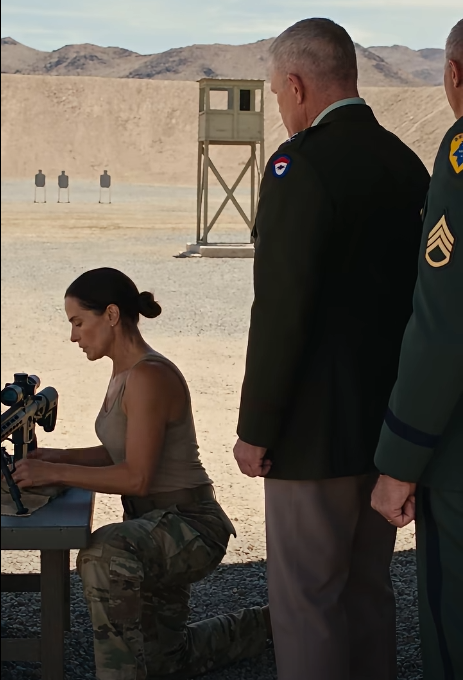
The cloth moved slowly through my fingers, wiping oil from the bolt carrier group of an M110 sniper rifle. Metal gleamed beneath the brutal Arizona sun.
Behind me, several pairs of boots scraped over gravel.
“Look at me when a superior officer is speaking to you.”
I kept working.
Not because I hadn’t heard him.
Because the second I looked up, I knew something buried for years might begin moving again.
Fort Maddox shimmered beneath waves of heat. Steel targets trembled in the distance, distorted by hot air, while dust coated my arms and sweat gathered beneath my faded tactical tank.
Gun oil. Scorched concrete. Dry desert wind.
The smells pulled at memories I had spent years learning not to touch.
The rifle lay disassembled around me with every component arranged precisely where it belonged. My hands moved from habit deeper than thought.
“State your name,” Blackwell repeated.
I fitted the cleaned component back into place.
Click.
“Sir,” I said quietly, “if you don’t know my name, you probably shouldn’t be standing on my range.”
Nobody laughed at first.
Then someone behind him gave a short, stunned chuckle.
I rose slowly and finally faced them.
Blackwell stood only a few feet away, ribbons covering his chest, silver at his temples, his expression hardened by decades of being obeyed without question. Five officers stood behind him.
One young lieutenant was already smirking.
To him, I was probably a contractor with an attitude.
Maybe some civilian specialist who had forgotten where she was.
Blackwell studied me.
“Your range?”
I nodded toward the distant firing lanes.
“Lane seven was recalibrated three months ago using the wrong wind variance. The tables in your range office are outdated.”
The lieutenant’s smile faded slightly.
“Your shooters are compensating by roughly point-three mils at distance,” I continued. “You might want that corrected before somebody misses something that matters.”
One officer glanced toward the range tower.
Another frowned.
Blackwell remained perfectly still.
“And who,” he asked, his voice dropping into something colder, “are you to correct my installation?”
For a moment, I considered giving him the answer.
Instead, I straightened.
The movement shifted the fabric across my shoulders.
And his eyes dropped to my back.
Everything changed.
The tattoo was old now, its black lines softened slightly with time—a sniper’s crosshair wrapped around a raven in flight. Coordinates ran through the spread of its wings.
Beneath them sat the mark that mattered.
Blackwell stopped breathing.
I watched the authority drain from his face one fraction at a time.
First confusion.
Then disbelief.
Then something far more difficult for a man like Preston Blackwell to hide.
Fear.
The lieutenant looked between us.
“Sir?”
Blackwell didn’t answer.
His eyes remained fixed on the ink as if the desert had opened beneath his boots.
I knew that expression.
Recognition was arriving slowly, dragging memories behind it that neither of us had expected to face beneath an Arizona sun.
His jaw loosened.
His lips moved once without sound.
When his voice finally came, it was barely above a whisper.
“That’s not possible.”
And from the way he was staring at me, I knew he had finally remembered exactly who was supposed to be dead. 👇
Blackwell took one step backward.
It was small enough that anyone watching from a distance might have missed it. But gravel shifted beneath his heel, and the sound seemed impossibly loud.
The young lieutenant’s smirk disappeared.
Blackwell looked at the officers behind him, then back at me.
“Clear the range.”
Nobody moved.
His voice hardened.
“I said clear the range.”
I watched one of the older officers behind him narrow his eyes. He was leaner than I remembered, gray beginning at his temples, but there was something familiar in the way he stood—left shoulder slightly lower than the right, as though his body still compensated for an injury that should have healed years ago.
My chest tightened.
Aaron Mercer.
I had not seen him since the night I vanished.
He was a colonel now.
For a moment, neither of us acknowledged the other.
Then his gaze dropped to the raven.
His face changed.
“Mara?”
The sound of my name struck harder than Blackwell’s command ever could.
Blackwell turned sharply.
“Colonel.”
Mercer barely seemed to hear him.
He stared at me as though every year between then and now had collapsed into the space of a breath.
“Mara Ellison?”
The lieutenant looked from him to me.
I swallowed once.
“Hello, Aaron.”
Mercer’s mouth opened.
Nothing came out.
Blackwell recovered first.
“Enough.”
He stepped between us, blocking Mercer’s line of sight.
“This conversation is over.”
“No,” I said.
It was the first time I had challenged him without calling him sir.
His eyes snapped toward me.
For fourteen years, I had imagined what I would feel if I ever stood close enough to Preston Blackwell to watch him realize I had survived.
Anger, maybe.
Vindication.
Some clean, satisfying sense that the universe had finally corrected itself.
Instead, I felt tired.
Not weak.
Just tired in a place beneath bone.
“You signed my death report,” I said.
The officers behind him became very still.
Blackwell’s expression hardened.
“You are confused.”
“Am I?”
“You’ve mistaken classified operational history for something you understand.”
I almost laughed.
The words were so familiar.
Not because he had ever said them to me before.
Because men like him always found a longer sentence when the truth was too short.
Mercer stepped around Blackwell.
“You died at Qarif Ridge.”
I looked at him.
The pain in his face was real.
That mattered more than I wanted it to.
“That’s what you were told.”
His lips pressed together.
“We saw the report.”
“I know.”
“We saw the recovery assessment.”
“There was no recovery.”
Mercer’s eyes flicked toward Blackwell.
Blackwell’s jaw clenched.
“You’re discussing restricted information in front of personnel without clearance.”
The lieutenant’s face had gone pale.
One of the other officers shifted uncomfortably.
I bent and picked up the rifle from the cloth.
Every body around me tightened.
I saw it happen and stopped immediately.
The weapon remained pointed safely toward the ground.
“Relax,” I said quietly.
I removed the magazine, locked the action open, checked the chamber, and laid the rifle on the bench.
The familiar motions steadied me.
Blackwell watched every movement.
He had seen these hands before.
Fourteen years younger.
Shaking from cold rather than age.
Wrapped around a radio handset in a valley where morning had never arrived.
“You heard me that night,” I said.
Mercer looked at Blackwell.
Blackwell’s face went flat.
“I don’t know what you’re talking about.”
“You heard my final transmission.”
“No.”
“You answered it.”
“No.”
The second denial came too quickly.
Mercer caught it.
So did I.
The desert seemed to become quieter around us.
I stepped closer.
Not enough to threaten him.
Enough that he had to decide whether to retreat again.
He didn’t.
“Tell them what I said.”
Blackwell stared at me.
“Mara,” Mercer whispered.
I kept my eyes on the general.
“Tell them.”
Blackwell’s nostrils flared.
“This is absurd.”
“What grid did I transmit from?”
His expression flickered.
That was all.
A fraction of a second.
But Mercer saw it.
Blackwell looked toward him.
Too late.
Mercer spoke slowly.
“The official report said her radio was destroyed before the withdrawal.”
No one answered.
Mercer took another step forward.
“If you received a transmission, sir, how do you know what she said?”
Blackwell’s eyes cooled.
“Be very careful, Colonel.”
Mercer’s shoulders squared.
Something in his face settled.
“I have been careful for fourteen years.”
Blackwell glanced toward the young lieutenant.
“Hale. Get range security.”
Lieutenant Hale hesitated.
The general’s stare sharpened.
“That was an order.”
Hale reached for his radio.
I expected fear to return.
Instead, something strange happened.
I felt calm.
The kind of calm that used to arrive just before a shot—when distance became mathematics and noise disappeared.
“Ask him about the north drainage,” I said.
Hale stopped with his hand near the radio.
Blackwell’s eyes met mine.
“Stop talking.”
Mercer went motionless.
The north drainage had never appeared in the official report.
Not once.
Not in the summary.
Not in the casualty packet.
Not in the letters sent to families.
Only six people had known where it was.
Five of us on the ground.
And the officer listening from operations.
Blackwell’s face betrayed him before his voice did.
“There was nothing in the north drainage.”
Mercer inhaled sharply.
I closed my eyes.
Just for a second.
When I opened them, Blackwell seemed to realize what he had done.
Hale lowered his radio.
One of the officers behind him whispered, “Sir…”
Blackwell turned.
“Not another word.”
But the damage had already happened.
Mercer’s voice was almost gentle.
“The north drainage was never in the record.”
Blackwell looked at him.
Mercer continued.
“You just placed yourself on the live command net.”
For the first time, Preston Blackwell looked trapped.
Not accused.
Not challenged.
Trapped.
He turned toward me.
“You have no idea what that operation was.”
“I know what it cost.”
“You know your piece of it.”
“I know you canceled extraction.”
His voice rose.
“I prevented an entire battalion from being pulled into an unauthorized engagement.”
There it was.
The words landed between us.
Nobody moved.
Blackwell seemed to hear himself only after he had finished speaking.
Mercer’s face emptied.
Hale slowly lowered his hand from his radio.
I felt something inside me go cold.
“You canceled it,” I said.
Blackwell looked away.
“Conditions changed.”
“We were still alive.”
“I had incomplete information.”
“I transmitted six times.”
“You were compromised.”
“There were four of us breathing.”
Blackwell’s mouth tightened.
“You were behind a line you had been explicitly told not to cross.”
“We were sent there.”
Silence.
Mercer stared at him.
Blackwell’s eyes shifted.
That tiny movement was enough.
Mercer stepped closer.
“Sent by whom?”
Blackwell did not answer.
I could hear my own breathing.
Fourteen years vanished.
For half a heartbeat I was back beneath a broken wall, dust filling my mouth, radio pressed against my ear, waiting for the sound of rotors that never came.
I had repeated our grid until my voice disappeared.
I had waited until the radio battery died.
And when the sky finally became quiet, I had believed the silence belonged to everyone.
My team.
My command.
The country I had trusted enough to follow into darkness.
Blackwell looked at me now and seemed almost angry that I was still standing.
“That mission was larger than you ever understood.”
“No,” I said. “It was smaller.”
His brow tightened.
“One man protecting his career.”
His hand curled at his side.
Mercer stepped between us before Blackwell could answer.
Not dramatically.
Instinctively.
The movement hurt more than I expected.
Because fourteen years earlier, Aaron Mercer had stood between me and danger exactly the same way.
I looked at his shoulder.
The old injury.
The uneven posture.
“You went back,” I whispered.
Mercer turned toward me.
His expression broke.
Blackwell spoke sharply.
“Colonel, do not answer that.”
Mercer never looked at him.
“We went back.”
Something inside my chest stopped.
I stared at Mercer.
He swallowed.
“Twice.”
The heat disappeared.
The range disappeared.
Even Blackwell disappeared.
There was only Aaron’s face.
“We were told you were gone,” he said. “Then I heard your call sign through the static. It lasted maybe two seconds.”
My fingers went numb.
“You heard me?”
“I heard you say Raven Three.”
My old call sign.
Two words I had not spoken aloud in fourteen years.
Mercer’s eyes shone, but he did not look away.
“Cole heard it too. So did Ramirez.”
I shook my head.
“No.”
“We turned the truck around.”
Blackwell’s voice cut in.
“You were ordered to withdraw.”
Mercer turned on him.
“And we disobeyed.”
Nobody breathed.
Mercer’s voice trembled now, not with fear but with something held too long.
“We made it halfway back before the road was closed. We went on foot. We searched until daylight.”
My knees felt weak.
I gripped the edge of the rifle bench.
All those years, one memory had lived inside me like a shard of glass.
The absence of footsteps.
The empty horizon.
The belief that no one came.
“You didn’t leave me.”
Mercer’s face folded.
“No.”
The word barely survived his throat.
“No, Mara.”
I looked away because I could not hold his eyes anymore.
The steel targets blurred in the distance.
For years I had trained myself never to cry when memory came.
Not in hospital rooms.
Not during interviews.
Not when someone slid a death certificate bearing my own name across a table and asked me to confirm the spelling.
But this was different.
Grief was terrible.
Relief could be worse.
My hand covered my mouth.
Mercer did not touch me.
He knew better.
He simply stayed close enough that I could hear him breathe.
Behind us, Blackwell said, “This changes nothing.”
I turned.
His authority had begun to fracture, but he was still trying to hold the pieces together through habit alone.
“It changes everything,” Hale said.
We all looked at him.
The young lieutenant seemed surprised by his own voice.
Blackwell’s stare hardened.
“Lieutenant.”
Hale’s jaw tightened.
“With respect, sir, you just admitted ordering the withdrawal.”
“You are not qualified to interpret this conversation.”
“No, sir.”
Hale looked at me.
Then at Mercer.
“But I’m qualified to remember it.”
For the first time that day, I saw Blackwell understand that rank was no longer enough.
He turned to the other officers.
“None of you will repeat a classified operational discussion.”
Mercer reached slowly into his pocket.
Blackwell stiffened.
Mercer removed his phone.
The screen was dark.
“I already requested the Inspector General duty officer,” he said.
Blackwell stared at him.
“When?”
“When you identified the north drainage.”
The general’s face went gray.
Mercer held his gaze.
“You taught me to document anomalies, sir.”
The sentence had no sarcasm in it.
That made it devastating.
Blackwell looked toward the range exit.
For one second, I thought he might simply walk away.
Then he looked at me.
“You planned this.”
I shook my head.
“No.”
“You came here to provoke me.”
“I came here because lane seven was wrong.”
The absurdity of that truth seemed to anger him more than anything else.
“You expect me to believe this was coincidence?”
“I stopped building my life around you a long time ago.”
His expression changed.
That landed.
I stepped closer to the bench and reached beneath the folded cleaning cloth.
Blackwell watched my hand.
I pulled out a small weathered plastic case.
Mercer went still.
The case was scratched almost white along one corner.
Inside was a memory card no bigger than a fingernail.
Blackwell stared at it.
For the first time, real panic reached his eyes.
“What is that?”
I held the case between two fingers.
“The part you thought burned.”
His mouth opened.
No sound came.
“The radio recorder,” Mercer whispered.
I nodded.
A village doctor had found it tangled in the torn shoulder strap of my vest after I collapsed near the drainage channel.
He had kept everything that came with me.
My tags.
The recorder.
A broken compass.
Three photographs sealed in plastic.
For years, investigators had possessed a digital copy.
I had kept the original.
Not because anyone asked me to.
Because some part of me needed one thing from that night that no general could rewrite.
Blackwell stared at the case.
“You don’t know what’s on it.”
“I do.”
His eyes sharpened.
“You listened?”
“Once.”
Only once.
That had been enough.
My own voice.
Mercer’s voice.
The operations channel.
And Blackwell.
Clearer than I remembered.
Mercer looked at me carefully.
“Why didn’t they use it?”
“They tried.”
“What happened?”
I looked at Blackwell.
“The investigation was compartmented. Then reassigned. Then narrowed. Then classified.”
Mercer understood.
Promotion by promotion.
Office by office.
The man who had buried the operation had risen high enough to stand on top of the grave.
Blackwell’s voice went low.
“That recording contains protected operational material. Hand it over.”
“No.”
“That property belongs to the United States government.”
“It has belonged to investigators for eleven years.”
His face changed.
I let him understand.
“The original never entered your chain.”
He stared at me.
For years, I had imagined that revelation with anger.
Instead, I felt almost nothing.
He had already lost.
He simply had not been formally told yet.
Two dark government vehicles appeared beyond the range gate.
Nobody spoke as they approached.
Dust rolled behind the tires.
Blackwell watched them come.
His shoulders remained square, but his hands had begun to tremble.
Barely.
The vehicles stopped.
Three people stepped out.
One wore an Inspector General identification badge.
Two were Army criminal investigators.
Blackwell closed his eyes.
Just once.
Then opened them.
The senior investigator approached.
“Major General Preston Blackwell?”
The general’s voice returned to its old command tone.
“I want counsel present.”
The investigator nodded.
“That is your right.”
Nothing dramatic followed.
No handcuffs.
No shouting.
No public spectacle.
Only a request for his government phone, his access card, and his cooperation while his command authority was temporarily suspended pending review.
That was how power actually broke.
Quietly.
Administratively.
In front of witnesses.
Blackwell removed his access card.
His fingers slipped once against the clip.
Hale looked down.
Mercer did not.
Neither did I.
Blackwell handed the card over.
For a moment, he and I stood facing each other beneath the same punishing sun.
“You think this gives you back fourteen years?” he asked.
I considered the question.
“No.”
His mouth twitched.
“Then what exactly did you win?”
I looked at Mercer.
At Hale.
At the officers who had watched a general’s version of reality collapse because one dead woman refused to remain dead.
Then I looked back at him.
“My name.”
He said nothing.
The investigators led him toward the vehicle.
He walked under his own power.
No one saluted.
That was the first silence.
The second came after the door closed.
It was deeper.
For years, Blackwell had existed in my mind as something enormous.
A voice over a radio.
A signature beneath my death.
A force capable of reaching backward through time and making my body remember cold ground.
Watching him disappear behind an ordinary vehicle door did something strange.
He became a man.
Nothing more.
Mercer sat beside me on the rifle bench after everyone else had moved away.
Neither of us spoke for several minutes.
The desert wind had picked up, pushing powder-fine dust over the concrete.
He rubbed his palms together.
I remembered that habit.
He used to do it before admitting something difficult.
“You should hate me,” he said.
I looked at him.
“Why?”
“We stopped searching.”
“You were ordered out.”
“We still stopped.”
His eyes remained on the gravel.
“At dawn, they told us another element would continue. Blackwell said aerial surveillance showed no movement. He told us the entire grid was lost.”
His jaw tightened.
“I believed him.”
“You went back twice.”
“Not far enough.”
“Aaron.”
He closed his eyes.
“Cole never forgave himself.”
The name hurt.
“What happened to him?”
“He left the Army three years later.”
“Ramirez?”
“Still in Tucson.”
I almost smiled.
“Of course he is.”
Mercer gave a broken little laugh.
For several seconds, we were young again.
Not truly.
But near enough to remember.
Then he reached into the inside pocket of his uniform blouse and removed a thin envelope.
The paper had been folded enough times that the creases had gone soft.
My name was written across the front.
MARA.
The handwriting was Cole’s.
I stared at it.
“What is that?”
Mercer’s thumb moved over one edge.
“We wrote letters.”
I could not speak.
“After they declared you dead.”
He placed the envelope on the bench between us.
“Mine is in there. Ramirez’s. Cole’s.”
I stared at the paper.
Mercer continued quietly.
“We weren’t allowed to send anything directly to your family because of classification. So we wrote them for the memorial.”
My throat tightened.
“I never had a memorial.”
“We did.”
I looked at him.
“Just us.”
His eyes met mine.
“No officers. No speeches. We went outside the wire at Bragg and sat behind an empty maintenance shed with terrible coffee.”
A laugh escaped me before I could stop it.
It became something else halfway out.
I bent forward, elbows against my knees.
Mercer waited.
“We kept your chair empty,” he said.
I covered my eyes.
“And Ramirez stole a bottle of bourbon so cheap Cole said surviving you would’ve been less painful.”
I laughed again.
This time I cried with it.
Mercer looked away and gave me the privacy of pretending not to notice.
When I could breathe again, I picked up the envelope.
“Why do you still have these?”
“Because we never buried them.”
I looked at him.
He swallowed.
“We couldn’t.”
That was the beautiful cruelty of grief.
Sometimes refusing to let go was the only evidence that love had been there.
I opened Cole’s letter first.
I read only three lines before I had to stop.
Not because they were dramatic.
Because they weren’t.
He had written about coffee.
About my terrible habit of stealing everyone’s clean socks.
About how I always corrected his wind calls even when I knew he was right.
Then, near the bottom, one sentence.
We came back for you.
I pressed the paper against my chest.
Fourteen years of silence shifted.
Not vanished.
Nothing that old vanished in an afternoon.
But it changed shape.
That mattered.
The investigation lasted seven months.
I testified behind closed doors first.
Then again before a military panel after portions of the operation were declassified.
Mercer testified.
So did Ramirez.
Hale submitted a written statement describing every word he had heard on the range.
The other officers did the same.
The recorder supplied the piece Blackwell had spent years making certain no file contained.
His own voice.
Ordering the rescue element to turn back.
Acknowledging my transmission.
Then instructing operations personnel to amend the timeline so that my final call appeared to have occurred before communications were lost.
The record did not need anyone to dramatize it.
It simply needed to exist.
Blackwell’s defense argued operational necessity.
Then memory.
Then classification.
Then confusion.
One by one, each explanation failed against his own words.
His command was permanently removed.
His clearances were revoked.
Months later, a general court-martial convicted him of charges tied to falsified official records, obstruction, dereliction of duty, and the concealment of the operation.
The day the verdict came, I sat alone in my kitchen.
No champagne.
No cheering.
The refrigerator hummed.
Rain tapped lightly against the window.
I read the message twice.
Then I put my phone facedown on the table.
My hands shook.
I thought I would feel triumph.
Instead, I thought of the younger version of myself waiting beside a dead radio.
Justice did not travel backward.
It could not lift her from that ground.
It could only reach into the present and say:
They should not have done that to you.
For the first time, I realized that might be enough.
Hale called three days later.
I nearly did not answer.
“Ma’am?”
“You can call me Mara.”
There was a pause.
“I wanted to apologize.”
“For what?”
Another pause.
“The range.”
I knew what he meant.
The smirk.
The assumption.
The easy confidence of someone who thought he understood another person by looking at their clothes.
“You looked at me like I was an idiot,” I said.
“I did.”
“That was stupid.”
“Yes, ma’am.”
I smiled.
“Mara.”
“Yes, Mara.”
His relief was audible.
“I’m trying to get better at not deciding who people are before they speak.”
“That’ll take a lifetime.”
“I figured.”
“That’s why you start now.”
He thanked me.
Before hanging up, he told me lane seven had been recalibrated.
Point-three mils.
Exactly.
I laughed for nearly a minute.
Three weeks later, Mercer drove to Tucson with me.
Ramirez opened his front door before we reached the porch.
He had grown heavier, grayer, softer around the face.
For half a second, he simply stared.
Then he whispered my name.
I nodded.
He turned away.
His shoulders shook once.
Twice.
Then he walked straight toward me and stopped three feet away.
“Can I?”
I understood.
I stepped forward.
He wrapped his arms around me.
Fourteen years collapsed into the space between one heartbeat and the next.
He smelled like laundry detergent, coffee, and the same cedar soap he had carried on deployment.
“You are such an asshole,” he said into my hair.
I laughed against his shoulder.
“So are you.”
“You were dead.”
“I heard.”
He pulled back and held my face between both hands.
“You look terrible.”
“You got fat.”
He laughed so hard his wife came running from the kitchen.
That night, we ate outside beneath strings of patio lights.
Mercer burned the steaks.
Ramirez blamed the grill.
His wife blamed Ramirez.
Nobody mentioned Blackwell for almost two hours.
That might have been the greatest victory of all.
Later, when the plates were empty and the night cooled, Ramirez brought out a small metal box.
My stomach tightened.
The box was dented at one corner.
I recognized it.
We had used containers like that for spare batteries and map tools.
He placed it in front of me.
“We buried this after the memorial.”
I looked at Mercer.
He nodded.
Ramirez opened the lid.
Inside were four things.
A raven patch.
A photograph of the five of us sitting on an armored vehicle.
A set of scratched dog tags.
And a folded topographic map.
My fingers stopped over the tags.
They were mine.
“I thought these were lost.”
“They were in your spare kit,” Mercer said.
Ramirez unfolded the map.
A circle had been drawn around a set of coordinates.
The same coordinates inked through the wings of the raven on my back.
I looked up.
“You knew?”
Mercer smiled faintly.
“We all knew.”
I had always believed the coordinates marked the place where everything ended.
The ridge.
The failed extraction.
The drainage channel where I survived alone.
Mercer turned the map around.
His finger moved half an inch south.
“No.”
I stared.
He tapped the circle.
“That wasn’t where we lost you.”
My skin prickled.
“It was where we found your first signal.”
I looked at him.
“The two-second transmission?”
He nodded.
“That coordinate was the reason we turned around.”
My hand moved unconsciously to the tattoo beneath my shoulder.
For fourteen years, I had carried those numbers as a memorial to abandonment.
I had put them on my body so I would never forget the place everyone stopped coming.
I had been wrong.
Those coordinates did not mark where they left me.
They marked the moment they heard me.
The moment they turned back.
The place someone chose me.
I stared at the map until the lines blurred.
Ramirez reached across the table.
His hand settled palm-up beside mine.
Not touching.
Waiting.
I placed my fingers in his.
Mercer looked toward the dark yard.
His eyes were wet.
“The tattoo,” he said.
I smiled through tears.
“I may have interpreted it badly.”
Ramirez snorted.
“You think?”
I laughed.
Something opened inside me then.
Not dramatically.
No sudden healing.
No clean erasure of pain.
Just space.
A little more room to breathe where grief had been taking up everything.
Months passed.
I returned to Fort Maddox in spring.
The desert was cooler.
Wildflowers had appeared in thin, stubborn patches beyond the range road, color growing where I had never noticed color before.
Hale met me at lane seven.
He had stopped smirking so much.
That alone was progress.
“The tables are current,” he said.
“I’ll be the judge of that.”
“Yes, ma’am.”
I looked at him.
“Mara.”
He sighed.
“I’m working on it.”
Mercer stood near the tower holding two coffees.
Ramirez had driven up from Tucson that morning and was already arguing with a range technician about wind flags.
For once, the sound of familiar voices behind me did not make my shoulders tighten.
The Army offered me a formal advisory position after the investigation.
I declined the first version.
Too much office.
Too many meetings.
Too many people using words like synergy.
The second offer involved instruction, precision-range evaluation, and mentoring small teams.
That one I accepted.
Not because I needed the institution to give me something back.
It could not.
I accepted because young soldiers deserved instructors who knew the difference between authority and truth.
They deserved to understand that obedience was not the same as silence.
And that a rank worn on someone’s chest could never make wrong data correct.
On my first official morning, I arrived before sunrise.
The equipment shed was still cool.
I set my coffee on the same bench where Blackwell had confronted me.
The M110 waited in its case.
I opened it.
Metal caught the first pale line of morning.
For a while, I worked alone.
Cloth.
Oil.
Steel.
Click.
The ritual had not changed.
Maybe I had.
Footsteps approached over gravel.
Three sets.
I froze for less than a second.
Old reflex.
Then Mercer’s voice came from behind me.
“You planning to ignore us all morning?”
Ramirez answered before I could.
“She’s hoping we’ll leave.”
Hale said, “Should we?”
I looked over my shoulder.
Mercer held coffee.
Ramirez carried breakfast sandwiches.
Hale had the corrected range book tucked beneath one arm.
The sun lifted behind them, throwing their shadows long across the gravel.
Years earlier, silhouettes approaching from behind would have meant danger.
For fourteen years after that, they would have meant memory.
Now they meant coffee.
Bad jokes.
People who knew where I had been and did not need me to pretend it had never hurt.
I stood.
Ramirez handed me a sandwich.
“You’re welcome.”
“I didn’t say thank you.”
“You were about to.”
Mercer looked toward the range.
“Wind’s picking up.”
“Two from the west,” I said.
Hale checked the flag.
“Two-point-five.”
I stared at him.
He lifted both hands.
“I’m learning.”
We walked toward lane seven together.
Near the firing line, I stopped.
A raven crossed high above the range, nothing dramatic about it, just a dark shape moving through clear morning air.
I watched until it disappeared beyond the ridge.
Then I looked at the three men beside me.
Mercer noticed.
“You good?”
For years, that question had felt impossible.
Good was too simple.
Good erased too much.
But that morning, beneath an Arizona sky washed clean with early light, I understood he was not asking whether the past had stopped hurting.
He was asking whether I was here.
Whether I was safe.
Whether I knew I was no longer alone.
I nodded.
“Yeah.”
And I meant it.
I turned toward the range, sunlight warming the old raven across my back, while the people who had once crossed darkness looking for me fell into step beside me.
For the first time in fourteen years, I walked forward without needing to look behind me.
I already knew who was there.