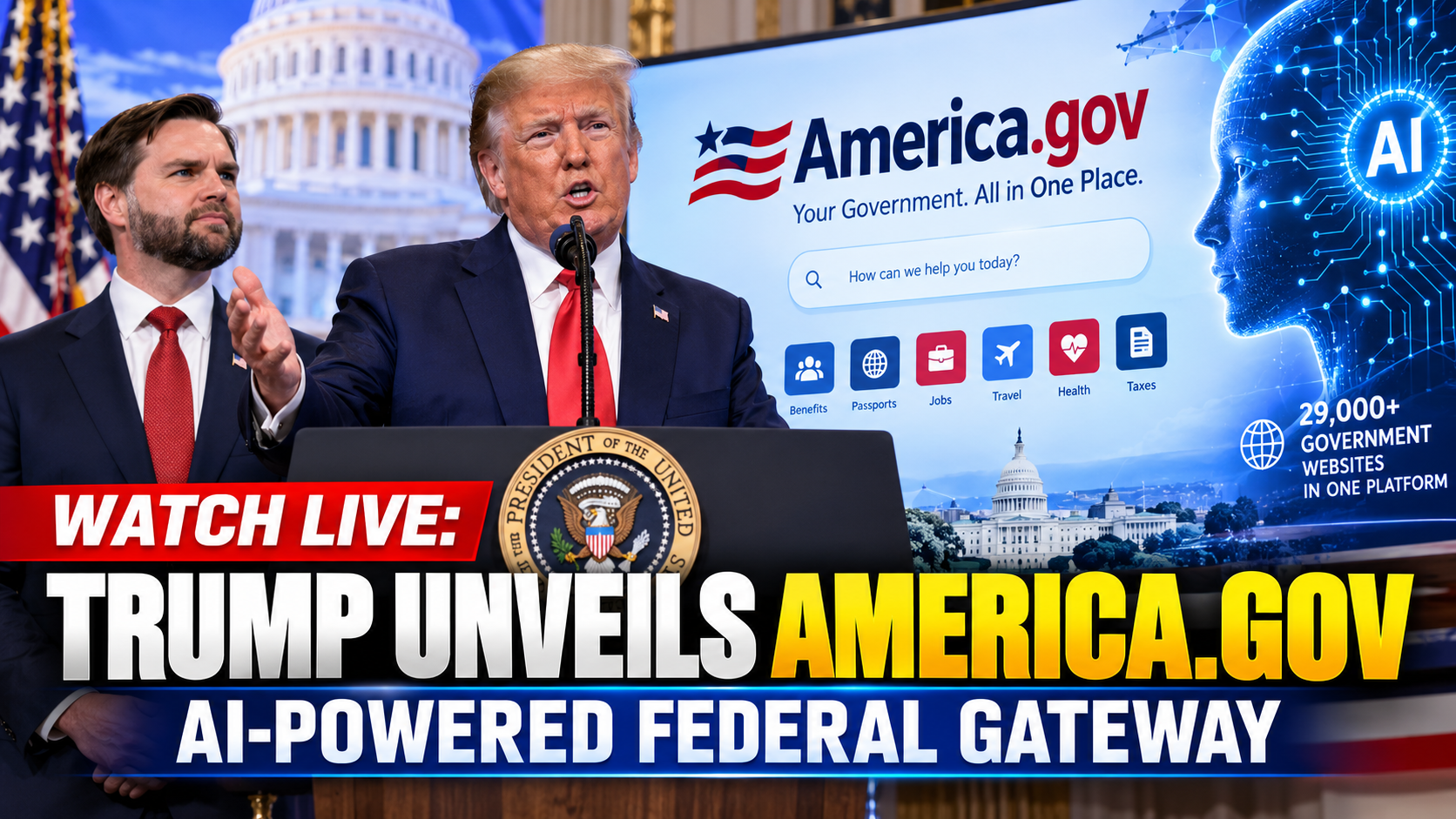
WASHINGTON — September 29, 2026 — President Donald Trump on Tuesday unveiled America.gov, a new artificial intelligence-powered federal gateway designed to provide Americans with a single entry point for information, government services and resources that are currently spread across thousands of government websites.
Vice President JD Vance participated in the launch alongside Trump and other senior administration officials as the White House presented the platform as part of its broader effort to expand the use of artificial intelligence across the federal government.
Developed with the White House National Design Studio and the U.S. General Services Administration, America.gov combines information from more than 29,000 government websites with AI-enhanced search technology. The administration describes the service as a new “front door” to government, intended to make it easier for people to find federal resources without having to know which agency operates a particular program or service.
The new website uses a chatbot-style interface that allows users to describe what they are looking for in ordinary language. Instead of navigating through multiple agency websites and separate search systems, users can ask questions about topics such as Social Security, passports, government benefits, national parks, employment opportunities and other public services.
According to the General Services Administration, America.gov is designed to help users find information and determine how to access government programs, including benefits and passport-related services. The system draws information from government websites and uses artificial intelligence to help organize and present those resources in a more accessible format.
The launch represents a significant expansion of the federal government’s use of artificial intelligence for public-facing services. The Trump administration has made AI development and deployment a major technology priority, including policies aimed at encouraging AI adoption within government while emphasizing cybersecurity and competition in advanced artificial intelligence.
Earlier this year, Trump signed an executive order focused on advanced artificial intelligence innovation and security. The order directed federal agencies to strengthen cybersecurity and expand the use of AI-enabled tools across government and critical infrastructure.
America.gov is intended to build on that broader effort by applying AI to one of the most visible interactions between Americans and the federal government: finding information and completing administrative tasks.
For many government services, citizens currently need to identify the appropriate agency, locate its website and determine which page or form applies to their situation. Federal agencies operate separate websites and systems, which can make it difficult for users who are unfamiliar with government organizational structures to locate the correct information.
The new platform attempts to reduce that complexity by allowing users to begin with a question or request rather than an agency name.
For example, a person seeking information about renewing a passport does not necessarily need to know which federal department handles passport services. Similarly, someone looking for information about Social Security benefits can begin with a question rather than searching through individual government webpages.
The administration has also indicated that the system is expected to expand over time. Initial versions of America.gov primarily function as an information and navigation platform, while future developments could allow users to complete additional government transactions directly through the service. Reports on the launch have described plans for capabilities involving applications, renewals and other online government processes.
The technology behind the system has also attracted attention. Reports have identified the use of advanced AI models and search technologies from private-sector companies, while officials have emphasized that America.gov is designed to draw its answers from government sources. The precise technical architecture and model configuration may evolve as the system expands.
The use of artificial intelligence in a government service also raises questions about accuracy, privacy and how automated systems should handle sensitive or politically significant information. America.gov itself advises users to verify important information with official government sources because AI-generated responses can require confirmation.
Those concerns are particularly relevant as AI systems become more involved in interactions between citizens and public institutions. Unlike a conventional search engine, an AI interface can summarize information and present an answer directly, meaning users may rely on the system without immediately reviewing the underlying government webpage.
The administration says the goal is to make government services easier to understand and access, while federal agencies remain responsible for the underlying programs and services.
The rollout also comes as the White House continues to promote the United States as a global leader in artificial intelligence. Trump has repeatedly emphasized the importance of maintaining American technological competitiveness, particularly as the United States competes with China in advanced AI development.