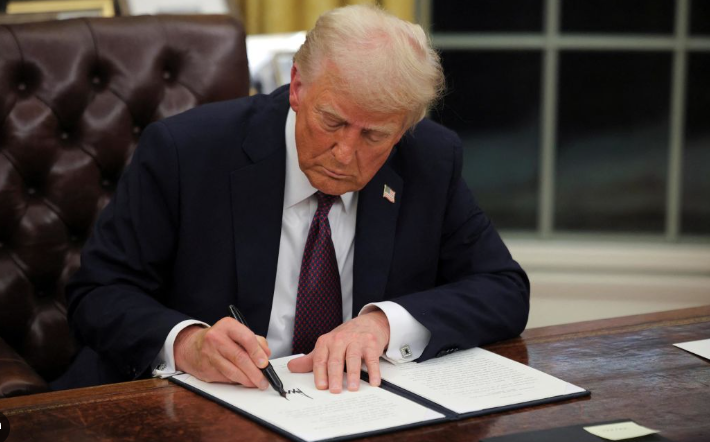
WASHINGTON — President Donald Trump signed an executive order on Tuesday titled “Restoring Integrity to America’s Financial System,” directing financial institutions to factor customers’ immigration status into risk assessments as part of the administration’s intensified immigration enforcement efforts.
The order builds on the 1970 Bank Secrecy Act, instructing the Treasury Secretary and federal regulators to issue guidance to banks on identifying customers and transactions that may pose risks related to money laundering, terrorism financing, and labor trafficking. It specifically highlights potential threats associated with foreign consular identification cards and outlines “red flags and typologies” of suspicious activity.
These indicators include repetitive large cash withdrawals, the use of shell companies to obscure ownership, off-the-books wage payments, and the reliance on Individual Taxpayer Identification Numbers (ITINs) instead of Social Security numbers for account opening or certain transactions. ITINs are available to all taxpayers regardless of immigration status and are primarily used for filing and paying taxes.
Administration officials argue the measures address vulnerabilities in customer identification practices that have allegedly enabled terrorists, drug traffickers, money launderers, and criminal networks — including Chinese-linked operations — to exploit U.S. financial institutions. A White House fact sheet stated that the order aims to “restore integrity” by cracking down on illicit activity and ending the extension of credit to high-risk borrowers, which officials claim ultimately raises costs for American citizens through higher fees and interest rates.
“Restoring sound underwriting standards puts money back in the pockets of law-abiding Americans,” the fact sheet added.
The policy arrives amid a broader immigration crackdown that includes restrictions on public benefits, heightened scrutiny of visa and citizenship applications, and large-scale detention and deportation operations. In November, the Treasury Department signaled plans to reclassify certain refundable tax credits as federal public benefits, further limiting eligibility for some non-citizens.
Critics warn that even legitimate non-citizens, particularly undocumented immigrants, could face greater barriers to basic financial services such as banking and credit. According to a study by the Urban Institute, lenders issued approximately 5,000 to 6,000 mortgages to ITIN holders in recent years. Banks have historically shown reluctance to extend loans to ITIN users, and government-sponsored enterprises Fannie Mae and Freddie Mac generally do not insure such mortgages.
The order also directs the Treasury to explore regulatory changes under the Bank Secrecy Act that would facilitate greater collection of customer data, including immigration status and employment authorization.
The move aligns with Trump’s long-standing criticisms of financial institutions. He has accused banks of political discrimination against conservatives and pursued a $5 billion lawsuit against JPMorgan Chase related to account closures following the January 6, 2021, Capitol events. JPMorgan Chase has maintained that decisions were driven by legal and regulatory risks, not political considerations.
At the same time, the administration has pursued deregulation benefiting non-traditional financial sectors and strongly supported cryptocurrency development, with Trump pledging to position the United States as the “crypto capital of the planet.”
Economists note that broader interest rate levels are primarily influenced by Federal Reserve benchmark policies, bank funding costs, and individual credit profiles rather than immigration-related lending alone. The executive order is expected to prompt further guidance from regulators and potential adjustments in banking compliance practices nationwide.